
Executive Dysfunction and Cleaning: How to Start When Your Brain Says “Nope”
You looked at the kitchen this morning.
You knew it needed attention. You even wanted to do something about it.
And then… nothing happened.
Not because you’re lazy. Not because you don’t care. But because somewhere between noticing the mess and actually cleaning it, your brain had to make about forty invisible decisions — and it ran out of fuel before you even got to the sponge.
If you have ADHD, autism, AuDHD, or struggle with executive dysfunction for any reason, cleaning can feel strangely impossible. Not just annoying. Not just boring. Impossible.
And when your home starts to feel messy, loud, or out of control, the shame can make the whole thing even harder to start.
If executive dysfunction and cleaning feel impossible together, it usually means the task needs fewer decisions, not more pressure.
So let’s talk about what is actually happening — and how to make cleaning smaller, clearer, and less overwhelming.
TL;DR: If You Are Frozen Right Now
If you came here because you are currently stuck, you do not have to read the whole post before doing something.
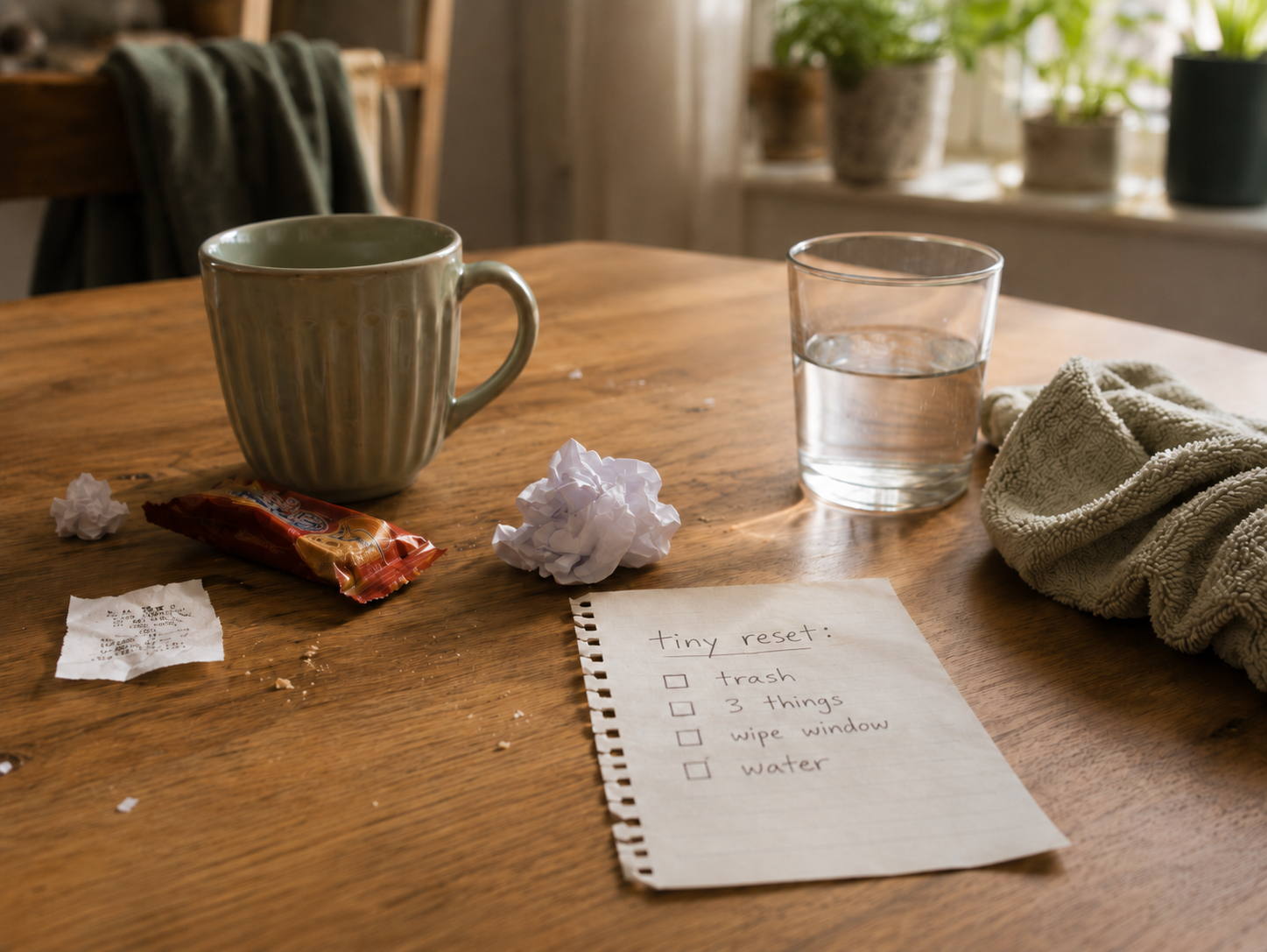
Try this tiny reset:
- Pick up anything that smells or leaks.
- Throw away three obvious pieces of trash.
- Clear one place to sit, stand, cook, or put something down.
- Open a window or turn on a light.
- Stop after five minutes.
That is enough for a first reset.
You are not trying to clean the whole room. You are just making the space 1% easier to exist in.
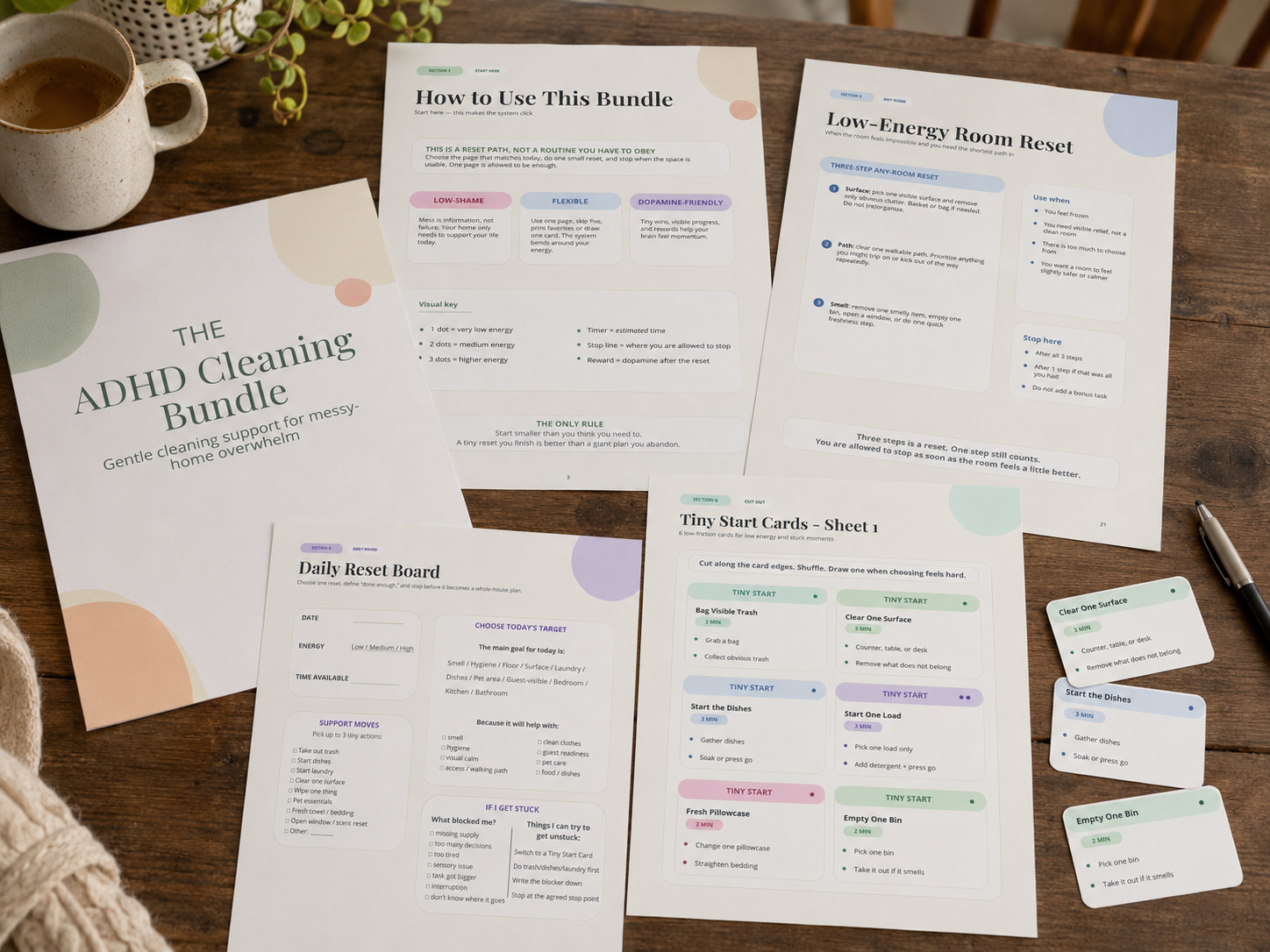
If choosing the next step is the hardest part, the ADHD Cleaning Planner Bundle gives you printable room resets, low-energy cleaning options, doom pile support, and task cards so you do not have to figure it all out from scratch.
Why Cleaning Feels So Hard With Executive Dysfunction
A lot of cleaning advice assumes you can simply “start somewhere.”
But for an ADHD or autistic brain, “start somewhere” is not a step. It is a whole task by itself.
Before you even begin cleaning, your brain may need to:
- notice the mess
- decide what matters most
- choose where to start
- figure out what “done” means
- gather supplies
- sequence the steps
- manage sensory discomfort
- keep track of what you were doing
- stop before you burn out
That is a lot.
So when someone says, “Just clean the kitchen,” they may not realise they are asking your brain to do planning, prioritising, sequencing, time management, sensory regulation, and task initiation all at once.
No wonder your brain says “nope.”
It’s Not About Motivation
Here’s the thing nobody says out loud enough:
The problem is not that you don’t care.
The problem is that cleaning has too many invisible steps.
You can care about your home and still not know where to start. You can feel stressed by the mess and still freeze when you look at it. You can desperately want a calmer space and still find yourself sitting on the sofa, scrolling, because every possible starting point feels too big.
That is not a character flaw.
That is executive dysfunction.
And executive dysfunction usually does not improve when you add more shame. It improves when you reduce the number of decisions between you and the first tiny action.
The Invisible Steps in Cleaning
Let’s make the invisible steps visible.
When you “just need to clean the kitchen,” your brain may actually be trying to answer questions like:
1. What am I supposed to notice first?
You might see the dishes, the crumbs, the sticky counter, the full bin, the random object pile, and the floor all at once.
When everything is visually loud, it can become harder to choose one thing.
2. Where do I start?
The kitchen needs attention, but so does the bathroom. The laundry is also there. The doom pile by the door has been waiting for three weeks.
Every option has its own weight.
Choosing between them requires prioritisation, which is an executive function skill.
3. What counts as “done”?
This one is sneaky.
If “clean the kitchen” could mean anything from rinsing one mug to deep-cleaning the oven, there is no clear finish line.
And without a finish line, starting can feel unsafe. Your brain does not know how much energy the task will take.
4. What supplies do I need?
Maybe there are no bin bags. Maybe the spray bottle is empty. Maybe you cannot find the gloves. Maybe the vacuum is in another room and getting it feels like a whole extra task.
A missing supply can become the thing that stops the entire reset.
5. What order do I do this in?
Do dishes come first? Or counters? Do you clear the floor before you wipe surfaces? Should you gather trash first?
For a brain that struggles with sequencing, the order of operations can be the thing that tips you from “about to start” into “I can’t do this.”
6. How do I deal with the sensory part?
Cleaning is not just physical.
It can involve smells, textures, wet food, sticky surfaces, loud water, strong cleaning products, visual chaos, and touching things you really do not want to touch.
If you are autistic, sensory-sensitive, burned out, or already overstimulated, this can be a real barrier.
7. How do I keep going without losing the thread?
You start with dishes.
Then you move something to the counter.
Then the counter needs clearing.
Then you find something that belongs in another room.
Now you are in that room.
Forty-five minutes later, you have technically been cleaning, but nothing feels finished.
That is not failure. That is working memory and task-switching making the task harder than it looks from the outside.
How to Start Cleaning When Your Brain Says “Nope”
You do not need a perfect routine.
You need a smaller entrance point.
Here are a few ways to make cleaning easier to start when executive dysfunction is high.
1. Pick the Loudest Mess, Not the “Most Important” Mess
When everything needs doing, “most important” can become too vague.
Instead, ask:
What is making the room feel loudest right now?
That might be:
- visible trash
- dishes with food on them
- laundry on the floor
- a smell
- one surface covered in random things
- something blocking where you need to walk or sit
You are not choosing the perfect task. You are choosing the task that will lower the most friction.
2. Set a Finish Line Before You Start
Before you begin, decide what “done enough” means.
Not perfect. Not deep-cleaned. Done enough.
Examples:
- The sink is usable.
- The floor is walkable.
- The bin is not overflowing.
- One surface is clear.
- The smell is gone.
- I can sit down without moving things first.
A clear endpoint makes the task feel safer because your brain knows it is allowed to stop.
This is also why I use “done enough” standards inside the printable ADHD Cleaning Planner Bundle — because a clear finish line can make starting feel less like falling into an endless task.
3. Choose One Cleaning Mode
Instead of “cleaning the whole room,” choose one mode.
Try one of these:
- Trash mode: only pick up rubbish.
- Dishes mode: only collect cups, plates, and bowls.
- Laundry mode: only gather clothes and towels.
- Surface mode: only clear one table, counter, or desk.
- Reset mode: only make the room slightly easier to use.
One mode is easier than a whole-room plan.
4. Use a Timer, But Keep It Gentle
A timer can help, but only if it does not turn into pressure.
Try saying:
“I am only cleaning for five minutes. When the timer ends, I can stop.”
Not “I must finish before the timer ends.”
The timer is there to protect your energy, not to punish you.
5. Remove One Decision
If you are frozen, do not ask yourself, “What should I clean?”
Ask a smaller question:
- What smells?
- What is in my way?
- What can I throw away?
- What would make this room 1% easier?
- What can I do without finding extra supplies?
The goal is not to solve the whole space. The goal is to get one decision out of the way.
6. Stop Before Burnout
This matters.
A lot of people with ADHD do not clean a little every day. They avoid it until the pressure becomes unbearable, then clean for hours, crash, and avoid cleaning again.
That cycle makes sense, but it is exhausting.
Try stopping while you still have a tiny bit of energy left. Even if the room is not finished.
Especially if the room is not finished.
A smaller reset that you can recover from is more useful than a huge clean that wipes you out for two days.
A Tiny Reset Example
Imagine it is 4pm.
You have not eaten properly. The living room looks like a paper explosion. You have been doom-scrolling because looking at the room feels too big.
A full clean is not happening today.
So the reset becomes:
- Throw away anything that smells or leaks.
- Pick up three things from the floor.
- Open a window.
- Drink water sitting down.
That is it.
The room is not clean.
But it is slightly less loud.
And you did not spiral.
That counts.
When a Printable ADHD Cleaning System Can Help
Sometimes the hardest part of cleaning is not the cleaning itself.
It is having to figure out what to do, in what order, with what energy, and when to stop.
That is why I created the ADHD Cleaning Planner Bundle.
It is a printable ADHD cleaning system for people whose brains do not respond well to vague advice like “just tidy up” or “clean as you go.”
Think of it as an ADHD cleaning checklist, reset guide, and task-card system in one printable bundle.
The bundle is designed to externalise the hard parts of cleaning, so your brain does not have to figure out the plan and do the task at the same time.
It includes support for:
- low-energy cleaning days
- room-by-room resets
- deep-cleaning without overwhelm
- doom piles
- daily reset routines
- “done enough” standards
- task cards for stuck days
- stopping before burnout
You can use one page, one card, or one tiny reset at a time.
You do not have to use the whole thing perfectly for it to help.
How the ADHD Cleaning Bundle Supports Executive Dysfunction
The bundle is built around one simple idea:
Your brain should not have to make every decision from scratch.
Instead of asking, “Where do I even start?” the energy check-in helps you choose what kind of reset fits today.
Instead of asking, “What counts as clean?” the “done enough” pages give you a realistic finish line.
Instead of trying to remember the order of steps, the room reset pages break cleaning into smaller sequences.
Instead of turning every pile into an emotional sorting project, the doom pile page keeps the scope small and specific.
Instead of pushing until you crash, the burnout prevention page reminds you that stopping is part of the system.
And on days when even choosing a page feels like too much, the task cards give you one tiny action at a time.
One card is allowed to be the whole plan.
A Note on Doom Piles
Let’s talk about the doom pile.
The doom pile, doom chair, doom table, doom basket, or doom corner is not a laziness pile.
It is an executive function traffic jam.
It often happens when there is no clear home for something, no obvious next step, or no energy left to make another decision.
So instead of trying to “organise everything,” start smaller.
Pick one pile.
Set up four destinations:
- keep
- bin
- donate
- relocate
Then touch each item once.
No opening memory boxes. No reorganising the whole room. No deciding to suddenly fix your entire storage system.
The goal is not to become a perfectly organised person in one afternoon.
The goal is to reduce the pile by one round of decisions.
One pile made smaller is a real win.
It’s a Reset Path, Not a Routine You Have to Obey
The ADHD Cleaning Planner Bundle is not meant to become another system you can fail.
It is not a strict schedule.
It is not a promise you are making to your future self.
It is not something you have to use every day for it to count.
It is a reset path.
You pick the page, card, or section that matches today. You do one small reset. You stop when your space is more usable.
That might mean five minutes.
That might mean one room.
That might mean one dish.
One page is allowed to be enough.
If Your Home Feels Impossible Right Now
If your home feels truly overwhelming right now — not just messy, but shame-triggering, anxiety-inducing, or built up from months of low capacity — please start smaller than your shame wants you to.
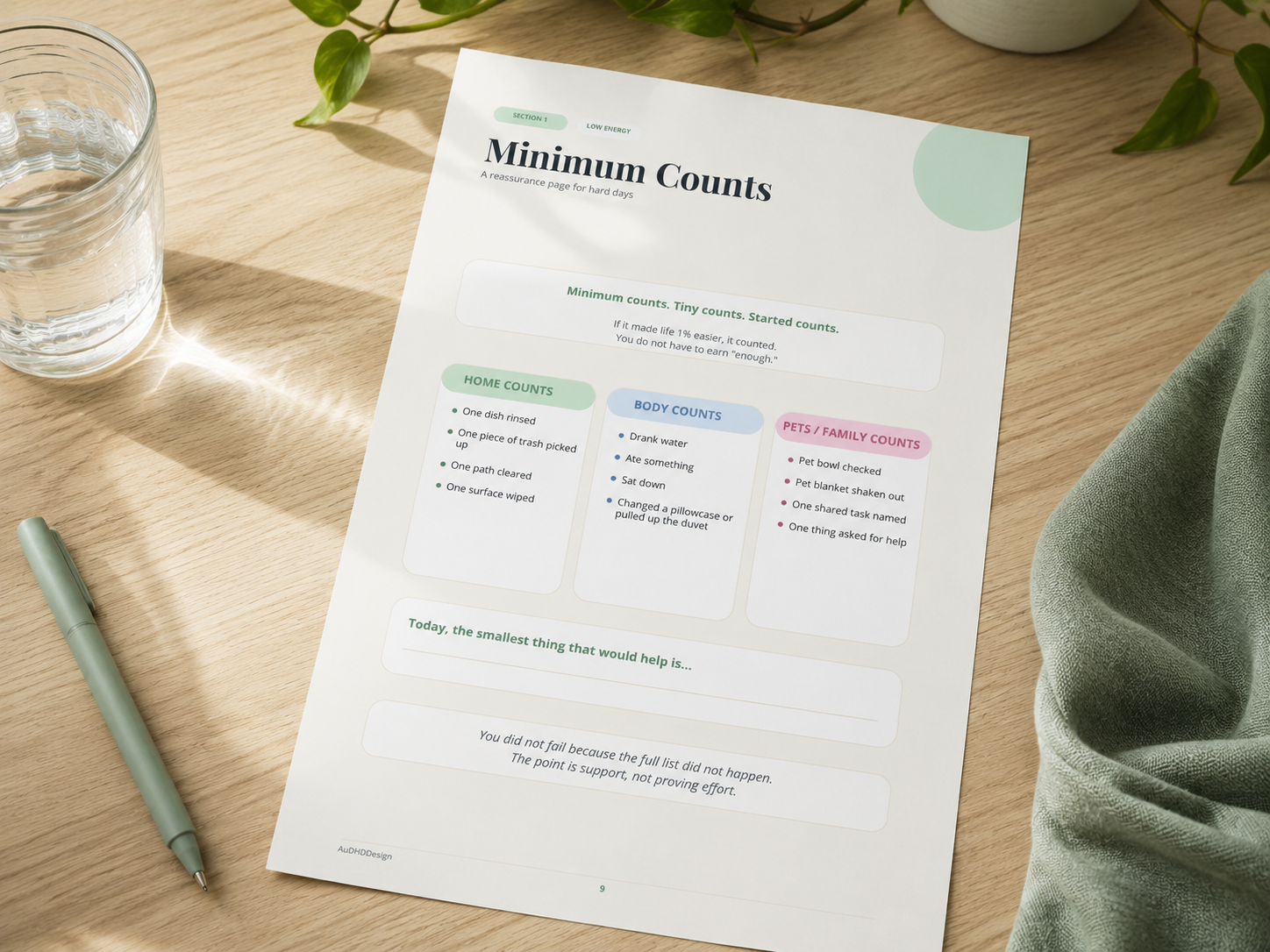
One dish rinsed counts.
One piece of trash picked up counts.
One window opened counts.
One cup of water next to you counts.
Sitting down before you crash counts.
You do not have to earn rest by finishing everything.
Your home only needs to support your life today. That is all it has to do.
Who the ADHD Cleaning Bundle Is For
The ADHD Cleaning Planner Bundle is for adults who struggle with cleaning because of ADHD, autism, AuDHD, executive dysfunction, burnout, depression, anxiety, chronic fatigue, sensory overload, or low energy.
It may help if:
- you freeze when you look at the mess
- cleaning feels like too many decisions
- you start cleaning and end up distracted in another room
- you struggle to know what “done” means
- you wait until the mess becomes unbearable
- you need low-energy options instead of all-or-nothing cleaning
- you want a printable system that gives you a starting point
You can use it printed on A4 paper, digitally in an annotation app, as individual room reset pages, or as cut-out task cards.
The system bends around your energy.
Not the other way around.
A Note From AuDHDDesign
AuDHDDesign is created by me, Sandra, a late-diagnosed AuDHD woman making printable tools for ADHD, autistic, and AuDHD adults who need low-shame structure for real-life stuck moments.
I create these resources because I know how unhelpful generic advice can feel when your brain is overloaded, your energy is low, or the “simple” task actually has forty invisible steps. The goal is not perfect productivity. The goal is to make everyday life a little easier to enter, use, and return to. I personally test my tools before publishing them, so they feel realistic, usable, and supportive — not just nice on paper.
You Don’t Need More Motivation
You probably do not need someone to tell you to care more.
You probably already care.
What you may need is a smaller first step, a clearer finish line, and a way to stop before cleaning becomes a whole-day recovery event.
A tiny reset you finish is better than a giant plan you abandon.
If that feels like something your brain needs right now, you can find the printable ADHD Cleaning System here.
Your home only needs to support your life today.
That is enough.
FAQ: Executive Dysfunction and Cleaning
Why is cleaning so hard with ADHD?
Cleaning can be hard with ADHD because it uses several executive function skills at once, including task initiation, planning, prioritising, sequencing, working memory, time awareness, and emotional regulation. A task that sounds simple, like “clean the kitchen,” may actually contain dozens of smaller decisions.
How do I clean when I have executive dysfunction?
Start by making the task smaller. Choose one visible problem, such as trash, dishes, laundry, or one surface. Decide what “done enough” means before you start. Set a short timer if that helps, and allow yourself to stop when the timer ends.
What should I clean first when I feel overwhelmed?
Start with the mess that causes the most friction. That might be something that smells, blocks your path, keeps you from using a space, or makes the room feel visually loud. You do not have to start with the “most important” task. Start with the task that makes life slightly easier.
Do ADHD cleaning checklists help?
ADHD cleaning checklists can help when they reduce decisions instead of adding pressure. The most helpful checklists are specific, flexible, low-shame, and broken into small steps. A good checklist should help you start, know what counts as done, and stop before you burn out.
What is a doom pile?
A doom pile is a pile of items that builds up when your brain runs out of decision-making energy. It might be clothes, papers, bags, random objects, or things that do not have a clear home. A doom pile is not a sign of laziness. It is often a sign that the next step was unclear or too effortful at the time.
How do I stop cleaning from turning into an all-day project?
Set a finish line before you start. Choose one room, one category, or one tiny reset. Avoid adding extra tasks halfway through. If you notice yourself spiralling into deep-cleaning, reorganising, or fixing unrelated areas, pause and return to the original goal.