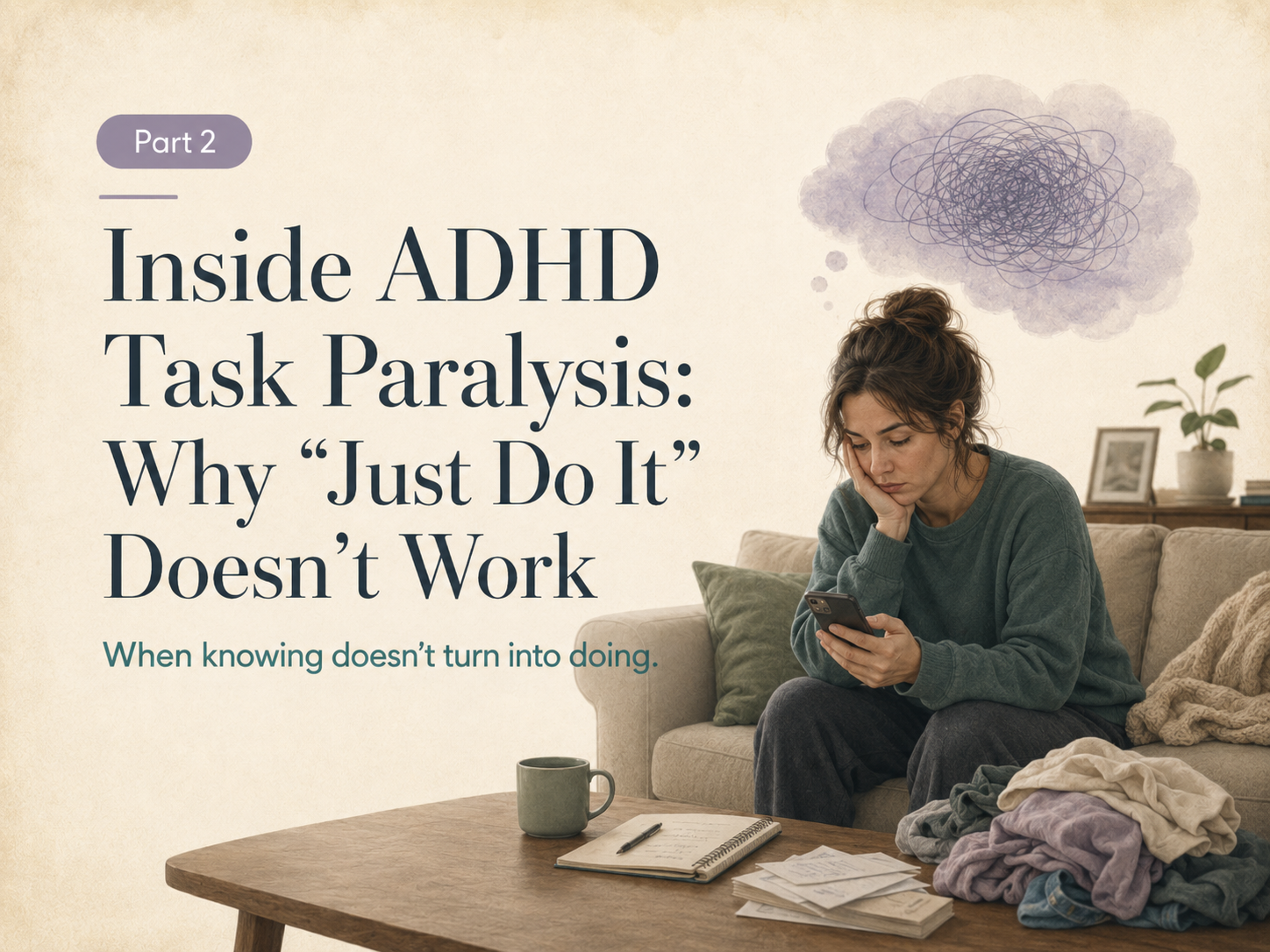
Inside ADHD Task Paralysis: Why “Just Do It” Doesn’t Work
You can see the task. You know why it matters. You may even be silently screaming at yourself to just get up and do it. But one of the hardest ADHD task paralysis symptoms is that knowing does not always turn into moving — like your mental engine is revving, but the car still will not start. And yet, you’re still exhausted at the end of the day, but this is a different kind of exhaustion: one that doesn’t get better by sleeping it off. We’ve learned a little bit about laziness vs executive dysfunction, now let’s look at what exactly executive dysfunction or ADHD paralysis is.
What is executive dysfunction?
Executive function is the group of mental skills that helps you plan, start, organize, remember, switch between tasks, manage time, regulate attention, and follow through. That list alone already tells us that it’s an important set of skills for every-day life.
It is the part of the system that helps turn:
“I need to clean the kitchen”
into:
“First I will put the plates in the dishwasher. Then I will wipe the counter. Then I will take out the trash. Now that I’ve done all that, I can take some time to relax.”
For many people, that process happens so automatically that they barely notice it.
For ADHD, autistic, and AuDHD brains, it can take much more effort.
The problem is not always the task itself. Sometimes the problem is everything around the task:
Where do I start?
What matters most?
How many steps are there?
What if I get interrupted?
What if I do it wrong?
How long will this take?
Why does this feel so much bigger than it looks?
From the outside, executive dysfunction can look like doing nothing.
From the inside, it can feel like a traffic jam.
There is effort. There is noise. There is pressure. There is caring. But nothing is moving smoothly. In fact, the traffic jam is so big that sometimes it seems you’ve been sitting in the same spot for hours, not even having moved a single inch towards your destination.
ADHD executive dysfunction: why “just start” is not always simple
ADHD and executive dysfunction can affect the invisible skills behind everyday life: planning, prioritizing, remembering, starting, staying with a task, and switching between steps.
That means the hard part is not always the physical action.
The hard part may be the bridge into the action, the part we see as ADHD task paralysis.
Picking up one mug sounds simple. But your brain still has to notice the mug, decide now is the moment, shift away from what you are doing, start moving, tolerate the sensory and emotional friction, and complete the step.
For a brain that struggles with task initiation, that bridge can feel missing. It doesn’t even need to be the whole bridge that’s missing. Sometimes you will notice the mug, decide to jump into action, you even managed to pull yourself away from your latest hyperfocus and start moving towards the sink…
But suddenly there was a gap in the bridge too big for you to jump over to the other side.
This could be anything from realizing you urgently need the bathroom because you weren’t aware of how full your bladder was, to something as simple as the doorbell ringing. So you put down the mug to take care of whatever needed your attention more that very second, and the cycle starts all over again because you’ve lost the momentum.
This is why “just do it” often does not help.
If trying harder worked, your mind wouldn’t constantly be fighting your body.
Why can’t I start tasks with ADHD?
If you have ever searched “why can’t I start tasks ADHD,” you are probably familiar with the painful gap between knowing and doing.
You know the dishes need doing.
You know the message needs answering.
You know the laundry needs switching.
You know the deadline is getting closer.
The knowledge is not missing.
The start button is.
For many ADHD and AuDHD adults, task initiation is affected by several things at once:
- The task is boring or under-stimulating
- The task has too many hidden steps
- The task feels emotionally loaded
- The task has no clear starting point
- The task is not visible enough
- The task requires a transition
- The task feels too big for the energy available
This is why advice like “just make a list” often falls flat.
A list can tell you what exists. It does not always tell your brain how to begin or what steps you might be missing if you didn’t think of those steps beforehand. ADHD task paralysis can act up when it doesn’t have enough information to actually complete the task. Useful worksheets that prompt you to break the task into tiny steps, like the one included in my Executive Function Workbook, can help you figure out what the smallest first step is that can you take.
ADHD task paralysis: what it feels like
ADHD task paralysis is a stuck state where you know what needs to happen, but you cannot easily begin. It can feel like freezing, scrolling, pacing, avoiding, or staring at the task while pressure builds. The issue is not lack of caring; it is difficulty moving from intention into action. This often creates shame and guilt.
For me, personally, when I experience ADHD paralysis, I often feel like people look at me like I’m a careless teenager again. As if I constantly need to be babied. Internally, this creates a lot of resentment. I am a mother of three, own 5 dogs, married, and work from home while my husband does heavy physical work; I should be able to do this and take care of my family. Why do I feel so stuck?
That stuckness can show up in very ordinary moments:
- The email you have mentally answered ten times
- The laundry sitting in the machine
- The appointment you need to book
- The dishes you keep walking past
- The form that would take five minutes but has taken three weeks
- The thing you promised you would get for someone
This is one reason the difference matters so much.
The outside view says, “You are not doing it.”
The inside view screams, “I have been trying to start for hours, can’t you see I’m really struggling here?”
Common executive dysfunction symptoms
Executive dysfunction symptoms can show up in your body, emotions, thoughts, and behavior.
- Feeling physically frozen: Your body feels heavy, tense, tired, or unable to move even when you have decided to start.
- Losing the first step: You know the final outcome, but you’re not quite sure what the next or even the first step is to get you to the end goal.
- Getting stuck in decisions: Tiny choices feel like they are huge, especially when there are too many options.
- Avoiding while caring: You avoid the task but keep thinking about it, feeling guilty about it, or checking whether it is still there.
- Waiting for urgency: You may only start when a deadline, crisis, or another person creates enough pressure.
- Starting the wrong task: You suddenly clean something unrelated, reorganize a drawer, or research a new system instead of doing the original task.
- Forgetting the task exists: Once something is out of sight, it can disappear from your working memory.
- Crashing after overdoing it: You finally get momentum, do everything at once, and then need at least a whole day of doing nothing to recover.
If this feels familiar, it does not mean you are broken.
It means your brain may need more support with the invisible parts of doing.
Why “simple” tasks are not always simple
A lot of shame comes from the word “simple.”
It is just one mug.
It is just one email.
It is just one phone call.
It is just one load of laundry.
But “simple” tasks often contain hidden steps.
Take “load the dishwasher” for example.
That might actually mean:
- Notice the dishes
- Decide this is the right moment
- Stand up
- Walk to the kitchen
- Clear space around the sink
- Empty the dishwasher if it is full
- Put clean dishes away
- Deal with old food
- Load the dishwasher
- Wash the pans that do not fit (This starts another list of approximately 10 steps in the middle of the list you’re currently following)
- Wipe the counter
- Remember to come back later if something needs soaking (which again starts another list)
For a brain that struggles with task initiation, sequencing, sensory overload, or decision fatigue, “do the dishes” is not one task.
It is a stack of tiny tasks wearing one large coat.
And if your brain cannot quickly sort that stack into a starting point, you may freeze before you even begin.
That freeze is often mistaken for laziness.
But laziness does not usually come with this much internal effort.
Knowing why your brain freezes is half the battle—but how do you actually break the cycle? Head over to the practical guide on low-energy strategies to get unstuck from executive dysfunction.
FAQ
What are executive dysfunction symptoms?
Executive dysfunction symptoms can include difficulty starting tasks, losing track of steps, forgetting what you meant to do, struggling with time awareness, avoiding tasks while feeling guilty, and becoming overwhelmed by decisions. These symptoms can affect home care, work, relationships, self-care, and daily routines.
Why can’t I just make myself do things?
Because “just do it” skips over the part where your brain has to organize, prioritize, initiate, and transition into action.
For many ADHD and AuDHD adults, that transition is exactly the part which makes them struggle.
It does not mean change is impossible. It means willpower alone is often the wrong tool. You may need smaller steps, clearer prompts, visual support, body doubling, lower sensory friction, or a different kind of starting point.
Does executive dysfunction mean I have ADHD?
Not always.
Executive dysfunction is common in ADHD, but it can also show up with autism, burnout, depression, chronic stress, sleep deprivation, trauma, long-term illness, and other situations that affect cognitive energy. Although executive dysfunction is often referred to as ADHD task paralysis by the ADHD community, executive dysfunction does show up in other situations too and it is not exclusive to ADHD.
If executive dysfunction is ongoing, distressing, or affecting several areas of your life, it may be worth talking with a clinician who understands neurodivergence.
Disclaimer: I am an advocate and creator sharing lived experience and functional tools, not a medical professional. This content is for educational purposes only and should not replace medical or mental health advice from a qualified healthcare provider.