Executive Dysfunction vs Laziness: Why You Aren’t Lazy
Executive dysfunction vs laziness can look confusing from the outside, because both can look like “not doing the thing.” But from the inside, they feel completely different.
Laziness usually feels like choosing not to bother.
Executive dysfunction feels like caring, stressing, trying to start, and still feeling stuck.
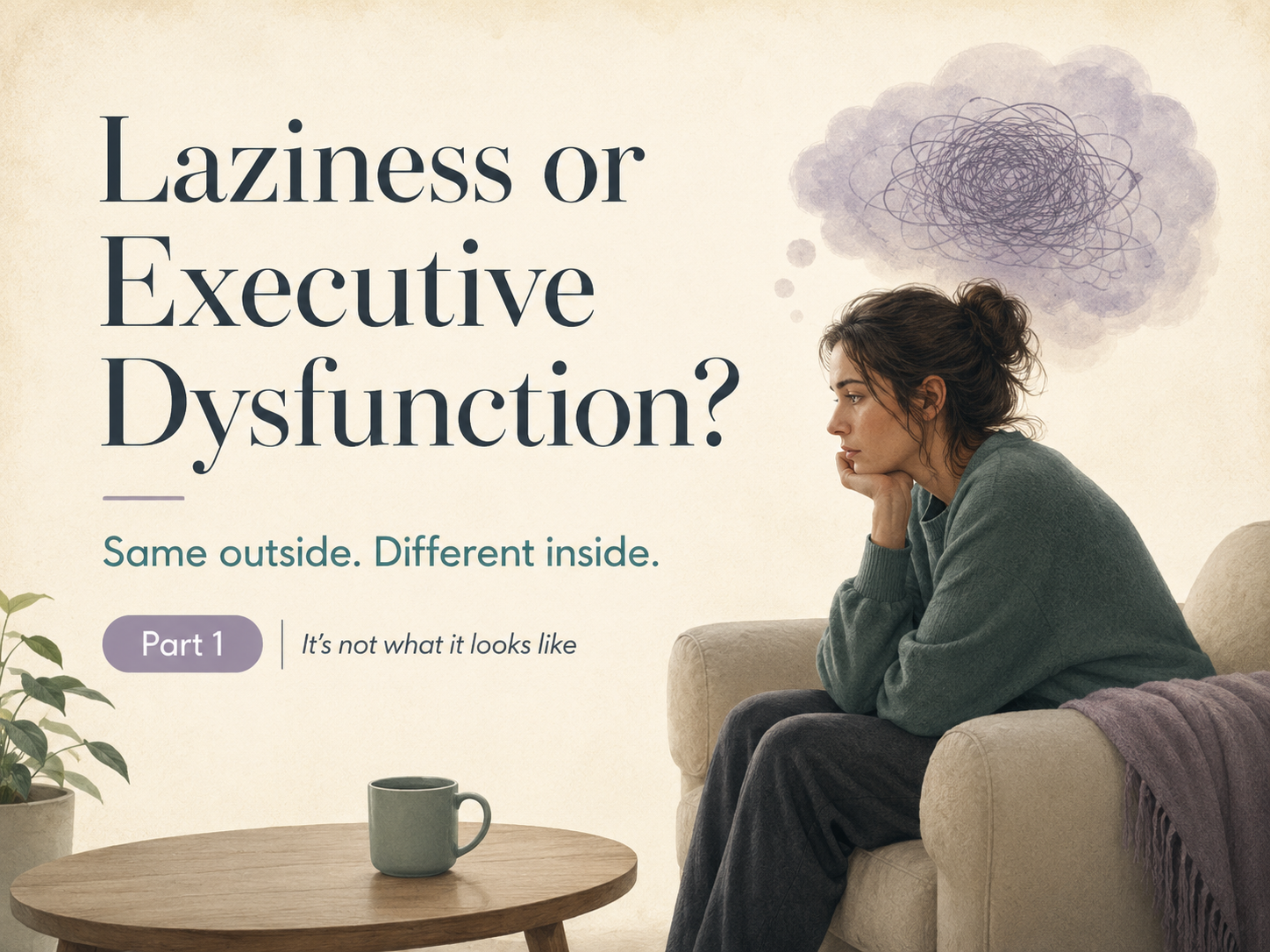
You’re on the couch.
The dirty mug on the coffee table has been staring at you since this morning, screaming at you to get up and clean it.
It would probably take less than ten seconds to pick it up, walk to the kitchen, and put it in the sink.
You know this.
You have known this for the past twenty minutes.
Your brain keeps saying:
Just do it.
It’s one mug.
Stand up.
Move your arm.
Why are you making this so hard?
Stop being so lazy.
But your body does not move.
Your limbs feel heavy. Your chest feels tight. The air around the task seems to get thicker the longer you look at it and before you know it, you’ve lost vision of the mug completely.
So you pick up your phone.
Not because scrolling feels good. Not because you are having a lovely little break. Not because this is what you truly want to be doing.
You scroll because it gives your brain somewhere else to go for a minute. Somewhere that is not the mug. Somewhere that is not the guilt. Somewhere that is not the voice saying, “See? You’re just lazy.”
But here is the part that voice leaves out:
If this were laziness, it would probably feel easier. Let me say that a little louder for the people in the back:
Lazy feels like rest. Executive dysfunction feels like an endless battle.
This does not feel easy.
This does not feel peaceful.
This does not feel like rest.
It feels like being stuck.
And for many ADHD, autistic, and AuDHD adults, that stuck feeling is part of executive dysfunction.
Understanding this difference can be deeply relieving, both for the person themselves and the people around them. Not because it magically makes the mug disappear, but because it changes the question from:
“What is wrong with me?”
to:
“What kind of support does my brain need right now?”
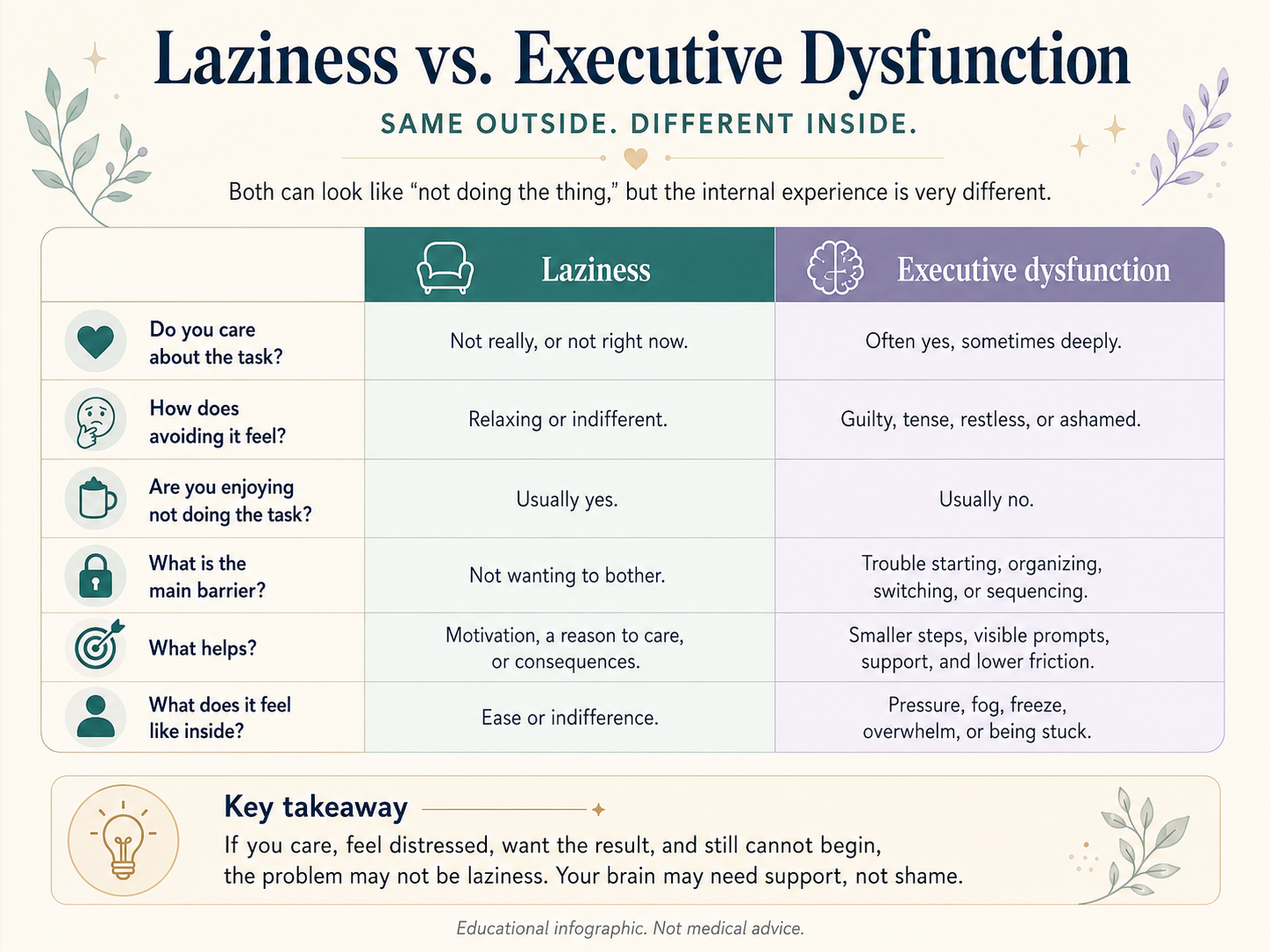
TL;DR: Executive dysfunction vs laziness
- Laziness usually feels like ease. You do not want to do the task, and you don’t really feel guilty about not doing it. You’re just fine with letting someone else handle it.
- Executive dysfunction feels like being stuck. You may care deeply, but your brain cannot easily move from intention to action. Willpower often isn’t enough.
- The main difference is distress. If you are guilty, tense, ashamed, or thinking about the task constantly, this is not peaceful rest. Looking like you’re relaxing doesn’t mean you are not fighting your own mind.
- Simple tasks often have hidden steps. “Do the dishes” is not one step, at least not for many neurodivergent people; it can involve noticing, deciding, starting, sequencing, switching, and finishing. Not to mention all the textures, smells and sensations that come with it.
- Support works better than shame. Smaller steps, visual prompts, body doubling, and low-energy versions can help create a bridge into action.
What is the difference between executive dysfunction and laziness?
Executive dysfunction vs laziness is the difference between being unwilling and being stuck. Laziness usually means choosing not to make an effort and feeling fine with that choice. Executive dysfunction means you do want the result, but somehow can’t make yourself do the thing. You feel distressed about not starting, and still struggle to turn intention into action.
That difference matters.
When people call themselves lazy, they often stop looking for support. They assume the problem is their character. It might even become a running joke, just to make it more socially acceptable because it’s not framed as a problem.
But if the problem is executive dysfunction, then the answer is not more shame.
The answer is better scaffolding.
Executive dysfunction vs laziness: quick comparison
| Question | Laziness | Executive dysfunction |
|---|---|---|
| Do you care about the task? | Not really, or not right now | Often yes, sometimes deeply |
| How does avoiding it feel? | Relaxing or indifferent | Guilty, tense, restless, ashamed |
| Are you enjoying the break? | Usually yes | Usually no |
| What is the main barrier? | Not wanting to bother | Trouble starting, organizing, switching, or sequencing |
| What helps? | Motivation, a reason to care or consequences | Smaller steps, visible prompts, support, lower friction |
| What does it feel like inside? | Ease | Pressure, fog, freeze, overwhelm, or being stuck |
This is why executive dysfunction can be so confusing.
From the outside, both can look like “not doing the thing.”
From the inside, they feel completely different.
This is also why executive dysfunction can cause a strain on romantic relationships. Personally, executive dysfunction was the reason I started the process of getting an official diagnosis; it was causing too much strain on my relationship and I needed to find out whether I was in fact just lazy or if I just needed a different type of support.
Why shame makes executive dysfunction worse
When you call yourself lazy, the task usually becomes heavier.
Now you are not only dealing with the mug, the dishes, the email, or the laundry.
You are also dealing with the story attached to it:
I am failing.
I should be better than this.
Other adults can do this.
Why am I like this?
It creates yet another obstacle in your way, even if it is ‘just‘ mentally.
Shame rarely makes the task smaller. It usually makes the doorway into the task feel narrower.
This is especially important for neurodivergent adults who have spent years being misunderstood. If you were often told you were careless, messy, dramatic, irresponsible, too sensitive, or not trying hard enough, everyday tasks can start to carry a lot of emotional weight. Like you’re constantly taking part in a competition you didn’t sign up for.
So when you avoid the task, you are not always avoiding the task itself.
Sometimes you are avoiding the feeling that comes with it.
That does not mean the task does not matter. It means your nervous system may be trying to protect you from more shame, more pressure, or more overwhelm.
A gentle way to tell the difference
You cannot always judge executive dysfunction from the outside.
But from the inside, you can ask questions that might be more useful so you can start understanding your own mind more.
Instead of asking:
“Am I just lazy?”
try asking:
- Do I care about this being done?
- Am I actually enjoying this break, or am I stuck in guilt?
- Does the task feel too vague, too big, too boring, too sensory, or too emotionally loaded?
- Would I be more likely to start if the first step was already decided for me?
- Would it help if someone sat nearby?
- Would it help if I could do an easier version instead of the detailed version?
- Would I start if I was allowed to do it badly?
If you care, feel distressed, want the result, and still cannot begin, the problem is probably not that you need more self-criticism.
You may need more support, more structure, less pressure, or a smaller doorway into the task.
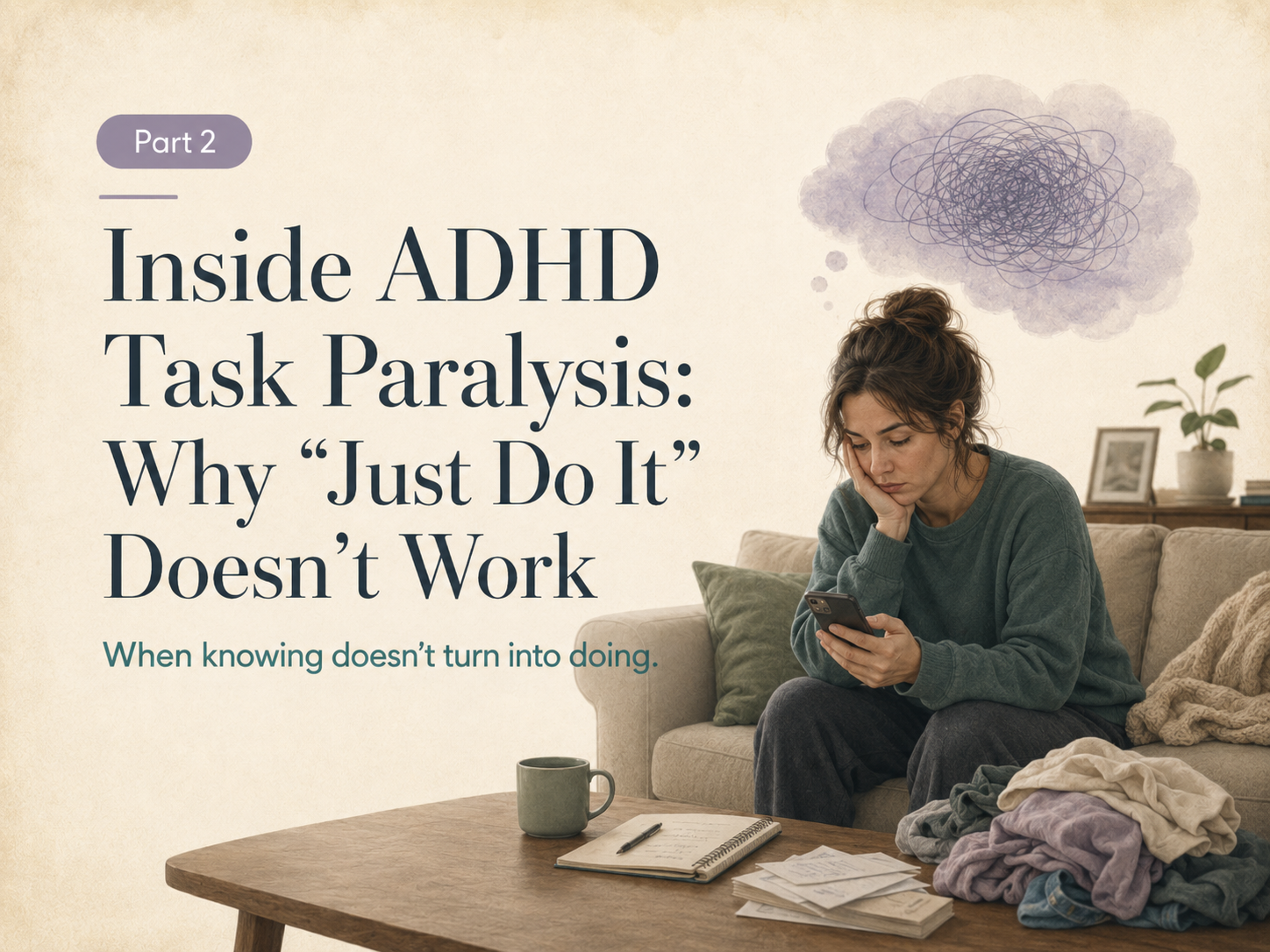
If you realize you aren’t lazy but are actually experiencing a total mental freeze, you might be dealing with task paralysis. Read our deep dive into [what ADHD task paralysis feels like and why it happens]. If you don’t feel like reading more right now, but would just like to see what might help silence the noise inside your head a little bit, feel free to check out my executive function support tools.
FAQ
Is executive dysfunction the same as laziness?
No. Laziness usually suggests that you do not want to make the effort and feel indifferent or even fine about not doing it. Executive dysfunction feels more like being blocked between wanting to do something and being able to start.
If you are distressed, guilty, overwhelmed, or constantly thinking about the task, that is a very different experience from simply not caring.
Can ADHD make you look lazy?
Yes, it can look that way from the outside.
ADHD can affect planning, attention, time awareness, motivation, working memory, and task initiation. That means an ADHD adult may struggle to start or finish tasks that look simple to other people.
But the outside view does not show the internal effort.
Someone may see you sitting still. They may not see the mental chaos, shame, decision fatigue, sensory overwhelm, or repeated attempts to get yourself moving.
How do you tell the difference between laziness and burnout?
Laziness, as people usually mean it, feels more like not wanting to bother or put in the effort.
Burnout feels like not being able to access your usual capacity, even for things you care about.
If even enjoyable things feel flat, impossible, or exhausting, that may be more than task avoidance. It may be a sign that your system needs real recovery, not more pressure.
Disclaimer: I am an advocate and creator sharing lived experience and functional tools, not a medical professional. This content is for educational purposes only and should not replace medical or mental health advice from a qualified healthcare provider.