Adult Sensory Overload: What It Feels Like, ADHD & What Helps
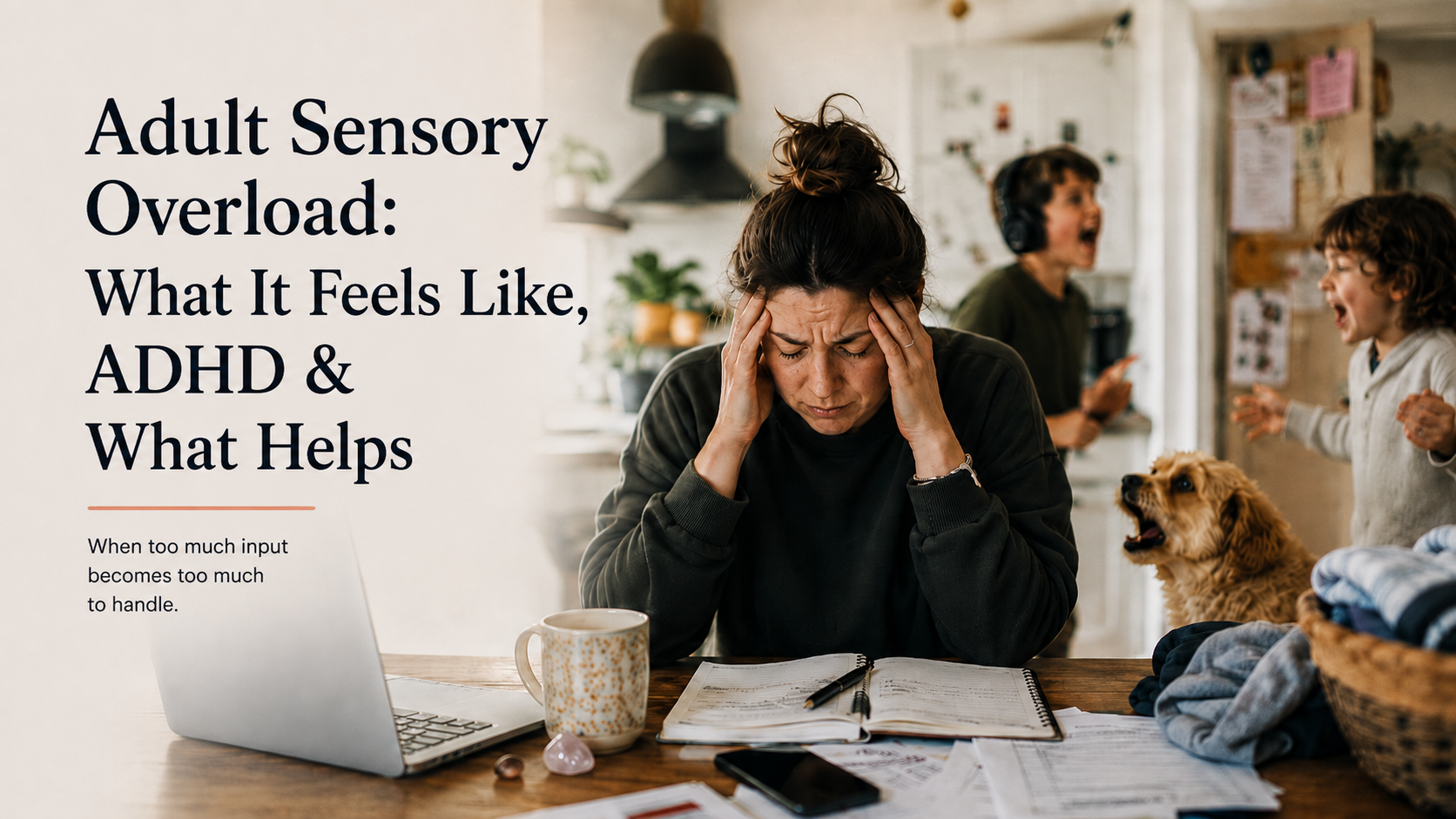
The extractor fan is going. Someone is asking you a question from the other room. The dog has started barking. Your socks don’t feel right. The children seem to think they need to shout through their headset even though the microphone is right there. It is too warm inside the house, and you somehow thought dinner would be ready within 20 minutes even though it always takes at least 45.
And then you stop.
You hide out in the bathroom waiting for this feeling to pass. Sense of time has left the building right now, but you know that it doesn’t matter how long you stay in this small room, you’re going to have to go back out there and you’ll feel the exact same way within a few minutes again.
You cannot think. You cannot find the next word. You cannot remember what you were doing and even though you hear that someone is talking to you, their words sound distant and are not registering. You might feel irritated for no clear reason. You might want to cry. You might go completely quiet. Or you might just need everyone and everything to stop making noise for approximately the rest of the week.
That is adult sensory overload.
And if it sounds familiar, I can promise you that you are not being dramatic. You are not bad at coping. Your brain and body may be responding to more input than they can comfortably process.
What Is Adult Sensory Overload?
Adult sensory overload happens when your brain receives more sensory input than it can comfortably process at once.
Most people experience some version of this occasionally: a very loud concert, a crowded train, a night out, a stressful supermarket line. But for many neurodivergent adults, especially adults with ADHD, autism, or AuDHD, the threshold can be lower, the experience can be more intense, and the triggers can be much more ordinary.
Sensory input does not only mean loud noise or bright light. It can include:
- Sound: background noise, overlapping voices, music, appliances
- Light: brightness, flickering, screens, fluorescent lighting
- Smell: food, cleaning products, perfume, other people
- Touch: clothing texture, being touched, temperature against skin
- Movement: busy environments, screens moving, people moving nearby
- Visual clutter: mess, too many objects, cluttered screens
- Social: notifications, messages, alert, conversations, masking
- Inner body: heat, hunger, tiredness, pain, and physical discomfort
- Mental: too many things to remember, too much info at the same time
Any of these might be manageable on their own. Several of them at once, after a long day, when you are already stretched thin? That is when overload can happen.
What Does Sensory Overload Feel Like?
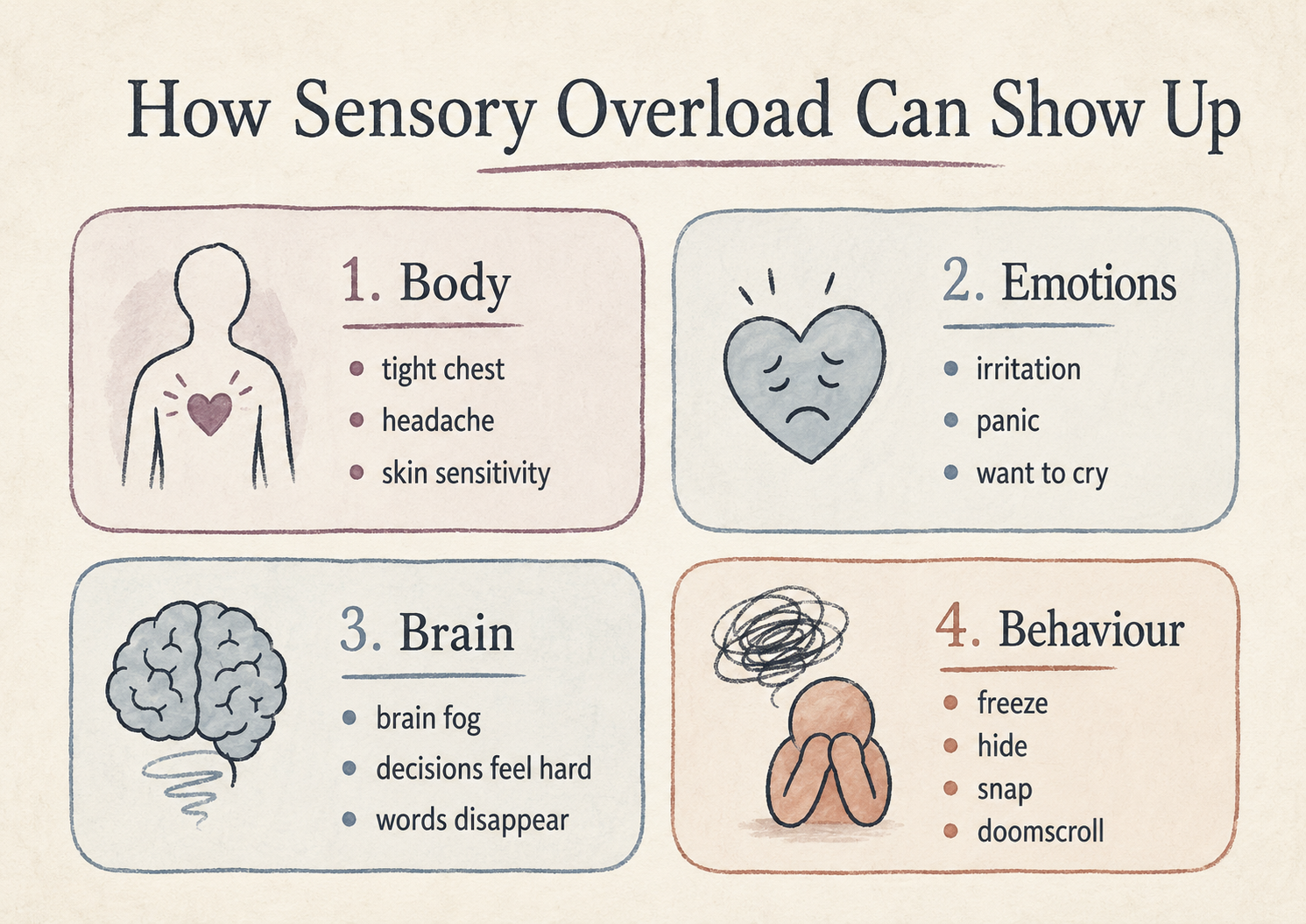
Sensory overload does not look or feel exactly the same for everyone. It can show up in your body, your emotions, your thoughts, and your behavior.
In your body
Sensory overload can feel physical before you even understand what is happening. You might notice:
- Tight chest or shallow breathing
- Headache or pressure behind the eyes
- Nausea or stomach tension
- Dizziness or feeling slightly unreal
- Skin crawling or feeling hypersensitive to touch
- Jaw clenching, shoulder tension, or whole-body stiffness
- Feeling too hot, too cold, or physically “wrong”
- Fatigue that arrives very suddenly
In your emotions
Emotionally, sensory overload can look like a sudden shift that feels out of proportion from the outside, even when it makes complete sense inside your body.
You might feel:
- Sudden irritation or anger
- Panic or urgency
- A desperate need to escape
- The urge to cry without knowing exactly why
- Emotionally flat, detached, or shut down
- Trapped by the environment around you
- Guilty because “nothing that bad happened”
In your brain
Cognitively, sensory overload can make ordinary thinking feel strangely difficult.
You might notice:
- Brain fog
- Words feeling far away
- Trouble following speech
- Forgetting what someone just said
- Struggling to make even simple decisions
- Forgetting what you were doing mid-task
- Feeling like everything is happening at once
- Not being able to work out what needs to happen next
In your behavior
From the outside, sensory overload may not look like “overload” at all. It might look like:
- Sitting completely frozen
- Going quiet or giving one-word answers
- Snapping at people you care about
- Hiding in the bathroom or another quiet room
- Canceling plans
- Avoiding messages
- Doomscrolling as a kind of mental escape
- Needing complete quiet
- Needing headphones and one specific sound to block everything else out
If you find it hard to notice overload building before it becomes a full shutdown, my Sensory Recovery Kit includes a printable sensory load scale and reset plan you can keep nearby. It is designed to help you track patterns and recognize early warning signs before everything becomes too much.
Sensory Overload Symptoms in Adults
When people talk about sensory overload symptoms in adults, they often focus on the emotional signs: irritability, anxiety, snapping, crying, or needing to leave.
But sensory overload can also be physical, cognitive, and behavioral. That matters, because many adults miss the earlier signs and only realize they were overloaded after they have already shut down, snapped, cried, or disappeared into their phone for an hour.
This is not a diagnostic checklist. It is a way to recognize possible patterns in your own experience, especially if you have spent years being told you were overreacting, too sensitive, difficult, dramatic, or not handling everyday life as well as you “should.”
Common patterns can include:
Physical symptoms
- Headaches
- Nausea
- Skin sensitivity
- Fatigue
- Tension
- Feeling unwell without a clear cause
- Needing to lie down or get away from stimulation
Emotional symptoms
- Irritability
- Suddenly needing to cry
- Panic
- Feeling trapped
- Feeling detached
- Feeling overwhelmed by ordinary demands
Cognitive symptoms
- Brain fog
- Word-finding difficulty
- Difficulty following conversations
- Decision fatigue
- Forgetting what you were doing
- Not being able to choose the next step
Behavioral symptoms
- Freezing
- Withdrawing
- Snapping
- Avoiding stimulating environments
- Canceling or delaying plans
- Needing significant recovery time after ordinary activities
If you regularly need a long time to recover after social events, supermarkets, busy workplaces, family gatherings, or noisy households, that recovery need is information. It is not weakness, in fact, it can be a strength once you learn to understand the information your body is trying to tell you.
Sensory Overload in ADHD
ADHD is often misunderstood by the general public as only an attention issue. You say ADHD, they say “Hey, look, a squirrel!”. Yes, very funny, haha, we’ve all heard that about a thousand times now. But many ADHD adults describe difficulties with much more than focus.
For some people, ADHD can affect how the brain filters, prioritizes, switches between, and responds to incoming information. That can make busy environments feel harder to process, especially when there are several types of input happening at the same time.
Many ADHD adults describe struggling with:
- Filtering input — background noise, movement, lights, or clutter may not fade into the background. All of it is heard and processed at the same time.
- Switching attention — moving from one thing to another can take real effort. Not because we don’t want to, but because we weren’t mentally ready yet.
- Emotional regulation — feelings can arrive quickly and intensely, including the emotional response to being overwhelmed. What looks sudden and out of proportion to others, can make a lot more sense when you understand the mental and physical state behind it.
- Task initiation — getting started requires cognitive resources that overload can deplete. Where one person might think showering involves turning on the shower, washing themselves and then getting out again, we see about 7 steps we need to take before we’ve even gotten to stepping into the shower.
- Processing competing demands — multiple questions, noises, tasks, and decisions can make the whole system stall. This could be because there’s too much input, too little input, or because we are having difficulty figuring out what the next step is.
For ADHD adults, sensory overload can feel like every sound, light, smell, task, and question is arriving at the same volume, with no way to turn any of it down.
When sensory input exceeds capacity, there may simply be less left for everything else. Less patience. Less ability to speak clearly. Less capacity to make decisions, start tasks, or regulate emotional responses.
This is not a personality failing. It is a capacity problem.
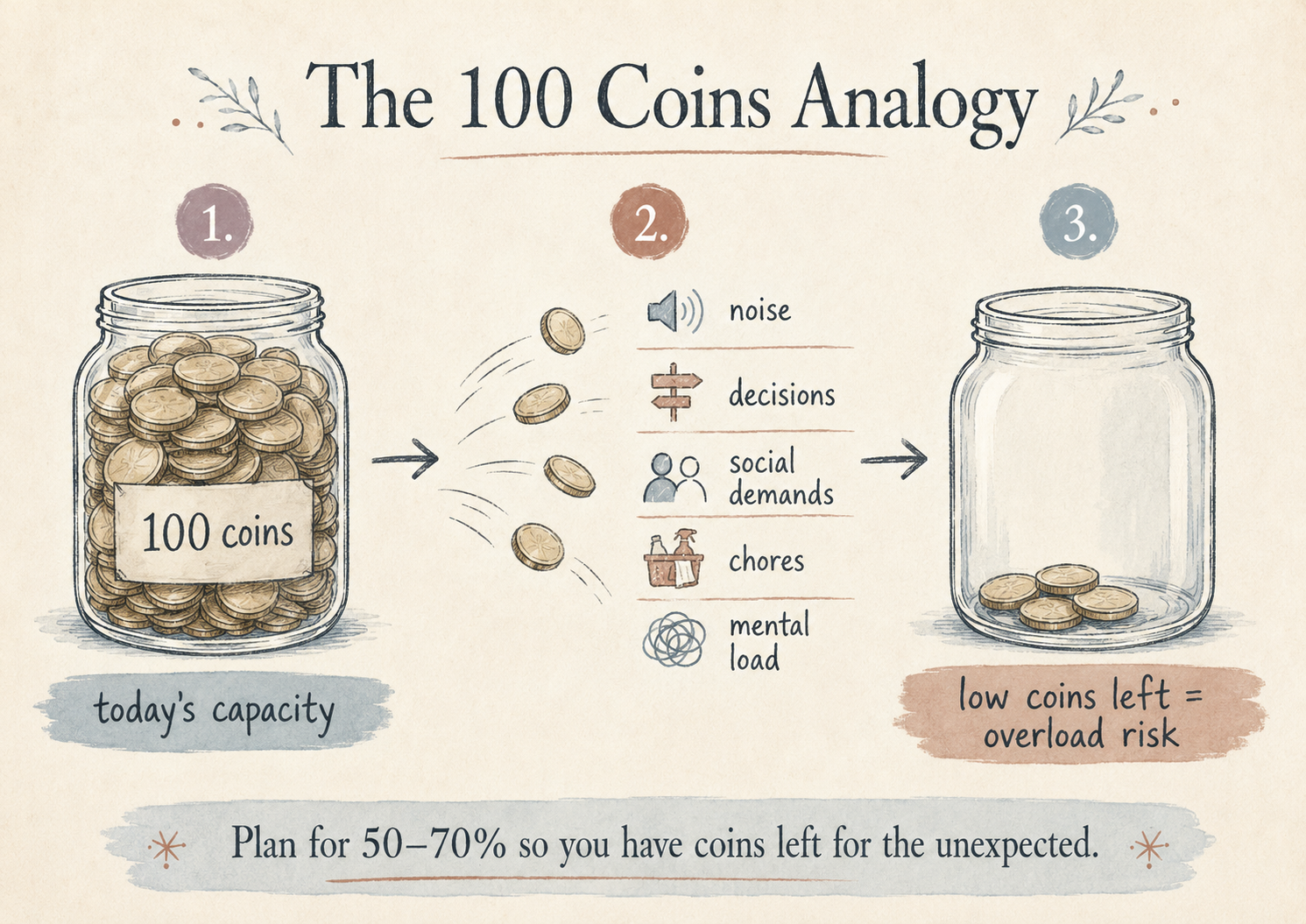
Think of it as a transaction. You have 100 coins. Each sensory input costs a certain amount of coins. Each action we take also costs a certain amount of coins. No one knows how many coins each action or sensory input costs exactly, we don’t even know ourselves most of the time. We only know that we have spent all of our coins for today and have nothing left to give.
The key is to try to ‘budget’ our coins for the things that we can control. That is what I based the Low Energy Planner on. I plan my days using only 50-70% of the coins I think I have, so that I hopefully have enough coins left for anything unexpected that may cost me more than I had planned to spend.
Overstimulated Adults Do Not Always Look Overwhelmed
One of the reasons adult overstimulation goes unrecognized, by professionals, partners, families, and even by the adults themselves, is that it does not always look dramatic. For outsiders, it may even look like someone is just being difficult, rude or uninterested.
Overstimulated adults might look like:
- Someone who went quiet at a social event and is now being asked if they are okay
- Someone who has been scrolling their phone for an hour and cannot explain why
- Someone who did not reply to a message and is not sure they ever will
- Someone who cannot choose what to have for dinner and is becoming increasingly distressed about it
- Someone who suddenly cannot bear to be touched, even by people they love
- Someone who wants everyone in the house to stop talking for five minutes, even if they weren’t being loud
- Someone who feels guilty because they are exhausted and “nothing bad actually happened today”
That guilt can be heavy.
When overload is triggered by ordinary daily life rather than a dramatic event, it can feel illegitimate. Speaking from my own experience, for me it felt like I was being too strict, too grumpy or simply exaggerating. But your nervous system does not grade inputs by how reasonable they seem from the outside. It responds to what is happening inside your body and brain.
Is It Sensory Overload, Stress, Anxiety, Burnout, or ADHD Paralysis?
These experiences can look similar, and they often overlap. A person can be stressed, anxious, burnt out, overstimulated, and stuck at the same time.
But it can still help to separate the patterns.
- Sensory overload = too much input coming in right now
- Stress = too many demands and not enough resources to meet them
- Anxiety = a threat or fear response, often future-focused, even when the threat is not actually happening right now
- Burnout = longer-term depletion from sustained overload, masking, pressure, or demand
- ADHD paralysis = feeling unable to start, choose, move, or act, even when you want to
They are not mutually exclusive.
Burnout can lower your overload threshold. Anxiety can add more internal noise. Stress can deplete your processing capacity. ADHD paralysis can happen during or after overload.
Can Sensory Overload Cause ADHD Paralysis?
Sometimes, yes.
When your brain is already overwhelmed by input, the cognitive resource required to make a decision, even a small one, may not be available. Choosing the next step requires working memory, executive function, and the ability to sequence.
Sensory overload can use up the very resources you need in order to act.
The result can look like ADHD paralysis: you are sitting there. You know you need to do something. You might even know what it is. But you cannot begin. You cannot move. You cannot make yourself go. For outsiders, it looks like you’re just relaxing and doing nothing. But you know better; your body is trying to fight your brain, and that is exhausting.
This is not laziness. It is a brain running on empty while still being asked to perform.
For these moments, tools that reduce decision-making can help. My Executive Function Support Kit is designed for stuck moments when you need a lower-demand way back into action.
Common Sensory Overload Triggers for Adults
Knowing your personal triggers can be genuinely useful. Not because you need to avoid all of life, but because it helps you plan, protect your capacity, and recover faster when overload happens anyway.
Common sensory overload triggers for adults include:
- Sound: background noise, overlapping conversations, the TV in another room, appliances, someone chewing
- Light: bright lights, flickering screens, fluorescent lighting, visual glare
- Visual input: clutter, busy patterns, crowded rooms, messy spaces you cannot ignore
- Environment: supermarkets, shopping malls, public transportation, open-plan offices
- Smell: strong perfume, food smells, cleaning products, candles
- Touch: scratchy clothing, tight waistbands, being touched after a long day, certain fabric textures, tags
- Physical state: hunger, heat, tiredness, illness, pain, hormonal changes
- Demands: too many decisions, too many questions, too many people needing something from you
- Domestic chaos: children, pets, household noise, mess, interruptions, competing needs
Triggers often compound.
One trigger might be manageable. Four triggers at once, especially when you are already tired, is a different situation entirely.
A Quick Sensory Reset When Everything Feels Too Much
When you are already overloaded, you do not need a complicated routine. You need fewer inputs and one clear next step.
Try this:
- Lower one input.
Turn down sound, dim a light, close a tab, leave the room, or put on headphones. - Move away from one trigger.
You do not have to fix the whole environment. Create a little more space between you and the input. - Give your body one simple support.
Drink water, change clothes, get under a blanket, sit down, lie down, or hold something familiar. - Stop explaining for now.
“I have reached my sensory limit. I need some space right now so I can reset myself.” That is enough. - Choose one next step.
Not the whole plan. Just the next small thing.
This is not about perfectly regulating your nervous system. It is about lowering the pressure enough for your brain and body to come back online.
What Helps When You Are Already Overstimulated?
When you are already in overload, the goal is not to analyze everything. The goal is to reduce input and help your system feel safe enough to recover.
1. Reduce input first
This is the most important step, and it has to come before problem-solving.
Dim the lights. Turn off or lower sound. Leave the room if you can. Put on noise-cancelling headphones or earplugs. Close the laptop. Change out of uncomfortable clothes. Remove whatever input you can remove.
You cannot think your way out of overload while the input is still happening at full volume.
2. Stop asking your brain to explain itself
You do not need to know why this particular moment crossed your threshold.
You do not need to justify it. You do not need to analyze whether it was “bad enough.” The question “why am I like this?” is not useful when you are mid-overload.
Put it down for now.
3. Give your body one clear signal of safety
Choose one physical thing that tells your body the emergency is over.
That might be:
- Changing into comfortable clothes
- Drinking water
- Lying down
- Getting under a blanket
- Sitting somewhere dark or quiet
- Holding a familiar object
- Using pressure, warmth, or a calming texture
It does not have to look impressive. It just has to be accessible.
4. Choose one next step, not a full plan
Do not ask your overloaded brain to plan the rest of the day.
Choose one thing.
Sit down. Drink water. Turn off the light. Send one message. Put one object away. Move to a quieter room.
If you’re having trouble choosing the next step, a visual schedule could be an option for you. Instead of writing down all the tasks for the week, you can see your next step with one single look at your schedule. Try to keep your options open by assigning different tasks to different energy levels. This way you don’t get stuck when you’re experiencing a low-energy day.
5. Recover before problem-solving
Whatever went wrong, whatever needs addressing, whatever you feel guilty about, it will still be there in twenty minutes, or an hour, or tomorrow.
Making decisions from the middle of an overload episode rarely goes well. Recover first. Problem-solve after.
A simple script for communicating with others:
“I am overloaded. I need quiet for a bit. I will be okay if you let me have this moment for myself.”
You do not owe anyone a full explanation while your brain is already overloaded.
How to Make a Sensory Overload Plan Before You Need It
The hardest moment to make a plan is when you are already in the middle of sensory overload.
Your brain cannot access the information it needs. You may not remember what helps. You may not be able to explain what is wrong. You may not be able to choose between options.
That is why the plan needs to exist before you need it.
A sensory overload plan might include:
- Early warning signs
What does overload feel like before it becomes a shutdown? Irritation? Tight shoulders? Noise suddenly feeling unbearable? Word-finding problems? - Common personal triggers
Not a generic list, but your actual patterns. - Things that help
Specific supports that work for you, not just general advice. - Things that make it worse
For some people, talking through the overload makes it worse. For others, silence feels scary. It helps to know your own pattern. - Scripts for people who support you
Something they can say or do that helps, and something they should avoid. - Low-energy reset options
Because sometimes you cannot do a full sensory recovery routine. You need a smaller step. - A reminder not to problem-solve too early
Written down somewhere you will actually see it.
This is the kind of moment I had in mind when I made the Sensory Recovery Kit: something you can fill in when you are calmer, so you do not have to invent a plan when your brain is already overloaded. It includes printable templates such as a sensory load scale, a sensory first aid plan, and early-warning prompts.
When to Get Extra Support
Sensory overload is not a character flaw, but that does not mean you have to handle it alone.
If sensory overload is frequent, severe, or significantly affecting your work, relationships, safety, or ability to function day to day, it may be worth speaking to someone who can help.
That might be:
- A GP or doctor
- A therapist who understands neurodivergence
- An occupational therapist
- An ADHD- or autism-informed professional
It is especially important to get extra support if overload is leading to panic attacks, shutdowns, self-harm urges, inability to leave the house, or a major loss of daily functioning.
You do not need to be in crisis to deserve support. Struggling is enough.
You Do Not Have to Earn Rest
Sensory overload is not a character flaw.
It is not drama, weakness, or poor coping. It is useful information.
Your brain and body are telling you that the input is too much right now. That is useful data, not a moral failing. You do not have to push yourself into shutdown to prove the overload was real enough to justify resting.
You are allowed to lower the input before you fall apart.
You are allowed to need quiet.
You are allowed to recover before you explain.
And you are allowed to build support systems that work with your actual brain instead of forcing yourself through the same overwhelm cycle again and again.
If you would like something practical to keep nearby, my Sensory Recovery Kit is designed for neurodivergent adults who want a simple, printable plan for moments when everything gets too loud. It gives you a sensory first aid plan you can prepare in advance and reach for when you need it most.
Frequently Asked Questions
What does sensory overload feel like in adults?
Sensory overload in adults can feel like a tight chest, sudden irritation, feeling the need to cry, brain fog, dizziness, skin crawling, the urgent need to escape, or the complete inability to think or speak clearly.
It varies from person to person, but many people describe it as a sense of too much arriving at once with no way to turn it down. Oddly enough, this can sometimes cause all sounds to become very distant and not register at all. Brains are complex like that.
Is sensory overload common with ADHD?
Yes, many ADHD adults report that noisy, busy, bright, or demanding environments are harder to filter. This is especially true when they are already tired, stressed, burnt out, or trying to manage several demands at once.
ADHD is not only about attention. For many people, it also affects executive function, emotional regulation, transitions, and the ability to filter competing input.
Can sensory overload make you freeze?
Yes. When your brain is processing too much input, the resources needed for decision-making and task initiation can become depleted.
This can look like ADHD paralysis: knowing you need to act, but feeling unable to start, move, choose, or think clearly. It is not choosing not to move. It is a system that has run out of capacity.
What helps when you are overstimulated?
The most important first step is reducing input.
Dim the lights. Lower sound. Leave the room. Change clothes. Put on headphones. Close screens. Then give your body one simple signal of safety, such as water, a blanket, lying down, or sitting somewhere quiet.
After that, choose one next step. Not a full plan. Just one step.
Is sensory overload the same as anxiety?
No, although they can overlap.
Anxiety is usually a threat or fear response, often focused on what might happen. Sensory overload is about too much input in the present moment.
They can happen together. Anxiety can lower your overload threshold, and sensory overload can trigger anxiety. But they are not exactly the same thing.
Disclaimer: I am an advocate and creator sharing lived experiences and functional tools, not a medical professional. This content is for educational purposes and should not replace clinical advice from a healthcare provider.
