What Is a Dopamine Menu for ADHD and How Do You Actually Use One?
You know that feeling when you hit a wall mid-afternoon and suddenly nothing sounds appealing?
Not the task you were supposed to do. Not anything on your to-do list. Not even the things you normally enjoy. You sit there staring at your phone and soon enough you find yourself stuck in a task paralysis doomscroll session.
For ADHD and AuDHD brains, that is not a personality flaw. It is often a sign that your brain is under-stimulated, depleted, restless, or looking for some kind of input it cannot quite name yet.
A dopamine menu is one of the gentlest and most practical tools for those moments. It gives your brain a list of options before you are too stuck to think of them.
Here is what a dopamine menu is, why it can help, and how to make one that actually fits your real life.
What is a dopamine menu?
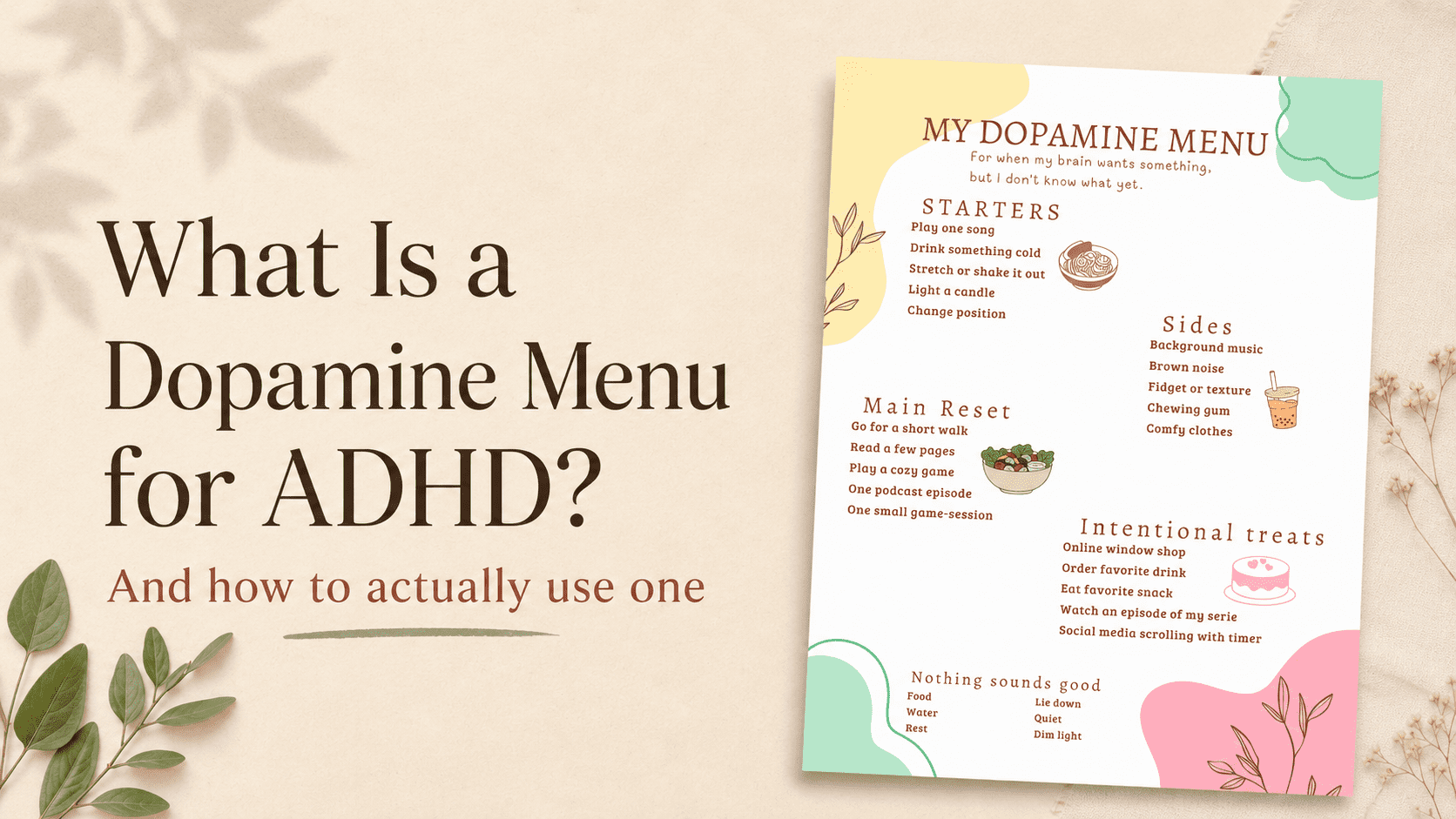
A dopamine menu is a personal list of activities organised into categories, a bit like an actual restaurant menu.
Instead of waiting until you are bored, foggy, restless, or halfway into a doomscrolling spiral, you create a list of options ahead of time. Then, when your brain needs a reset, you do not have to come up with an idea from scratch.
You can simply open the menu and choose something that matches the kind of input you need.
The categories are usually set up like this:
Starters
Quick 2–5 minute boosts that do not pull you in for too long.
Examples: open a window, drink something cold, play one song, stretch, step outside for two minutes.
Mains
Longer, more absorbing activities for a real reset.
Examples: take a walk, do a craft, play a cosy game, take a shower, make something, read a few pages.
Sides
Small things you can do alongside another task.
Examples: background music, a fidget, a warm drink, a candle, a weighted blanket, a podcast while folding laundry.
Desserts
Enjoyable treats that can be lovely, but may need a little boundary around them.
Examples: watching an episode, scrolling with a timer, playing a game, ordering a favorite drink, browsing Pinterest.
Specials
Bigger reset options for days when you need more support.
Examples: a full comfort routine, visiting a favourite place, asking for body-doubling, having a proper rest day, doing a sensory reset.
The point is not to turn fun into homework. The point is to make supportive options easier to reach when your brain goes blank.
Why do ADHD brains need a dopamine menu?
ADHD is linked to differences in reward, motivation, attention, and task initiation. This means that low-reward, repetitive, boring, or unclear activities can feel much harder to begin, return to, or stay with.
But dopamine menus are not only about productivity.
They are also about those moments when your brain feels flat, restless, irritated, foggy, or pulled toward whatever gives the quickest hit of stimulation.
The problem with asking yourself “What do I feel like doing?” in that moment is that the part of your brain responsible for generating options may already be tired. You might technically have plenty of things you enjoy, but none of them come to mind when you need them.
That is where a dopamine menu helps.
It externalizes the decision. The thinking has already been done. You open the menu, notice what kind of input your brain might be looking for, and choose one thing. Externalizing the decision can help a lot if you also struggle with executive dysfunction.
How is this different for AuDHD brains?
If you are AuDHD, meaning you have both ADHD and autism, a standard dopamine menu can still be helpful. But it often works better when it is built with sensory needs and predictability in mind.
For AuDHD brains, the answer is not always “more stimulation.”
Sometimes your ADHD brain may want novelty, movement, sound, or excitement. At the same time, your autistic nervous system may be close to overload and need quiet, sameness, pressure, softness, or predictability.
That means your dopamine menu should not only ask:
“What sounds fun?”
It can also ask:
“What kind of input would actually help me feel more regulated?”
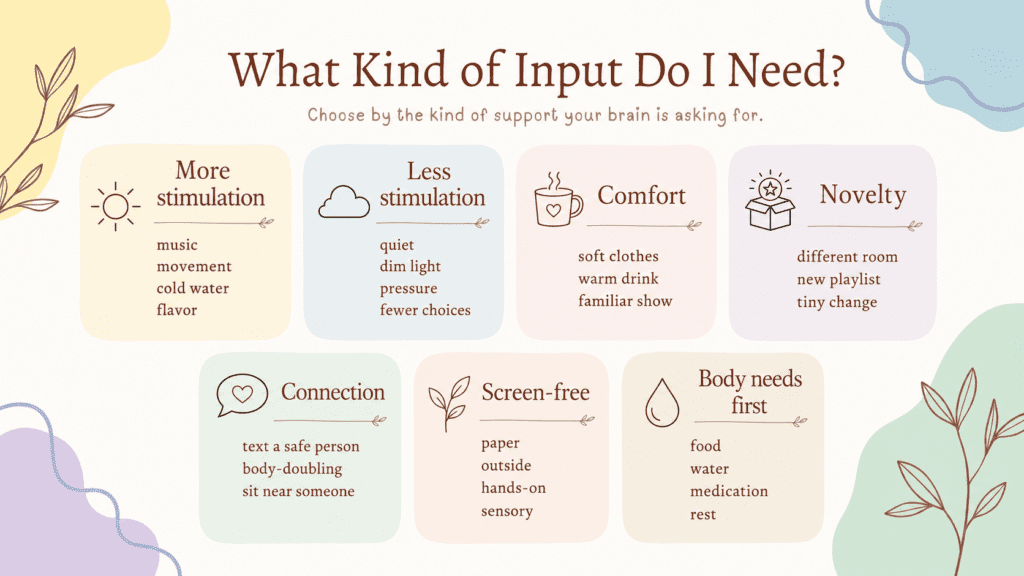
Some helpful categories to think about are:
Movement: walking, stretching, dancing, shaking out your hands, changing rooms.
Sound: music, brown noise, silence, a familiar podcast, one specific song.
Texture: a soft blanket, a fidget, warm water, skincare, comfortable clothes.
Visual input: fairy lights, a cosy video, a tidy corner, sunlight, a favourite colour.
Taste: tea, chewing gum, a crunchy snack, something cold, something warm.
Connection: texting one safe person, sitting near someone, body-doubling, parallel play.
Novelty: changing location, trying a different pen, rearranging one tiny area, choosing a random prompt.
Comfort: a familiar show, a safe routine, a weighted blanket, a low-demand activity.
The goal is not to chase the biggest dopamine hit. The goal is to find the kind of input that helps your brain feel a little less stuck.
Worth knowing
Your dopamine menu should feel like a relief to look at, not a to-do list. Something that brings you calm or joy.
If it feels like pressure, it needs editing.
A good dopamine menu does not shame you into making better choices. It gives you kinder options when your brain is reaching for the nearest easy thing.
How to build your dopamine menu
Start small. You do not need a perfect 20-item menu on day one.
Begin by thinking back to the last few times you genuinely felt a little better after doing something. Not perfectly fixed. Not suddenly productive. Just a little more human, awake, settled, or connected.
What helped?
Maybe it was stepping outside. Maybe it was putting on music. Maybe it was eating something crunchy. Maybe it was watching one familiar video. Maybe it was sitting on the floor with your pet. Maybe it was doing something creative with no purpose.
Write those things down first.
Then add options across different types of input:
- things that give you movement
- things that give you comfort
- things that give you novelty
- things that give you quiet
- things that give you sound
- things that give you texture
- things that give you connection
- things that do not involve a screen
Make sure there are a few options that are genuinely easy. Not “go for a beautiful 45-minute walk and become a new person.” More like “stand outside for two minutes” or “put on one song.”
A dopamine menu works best when it fits the version of you who is already tired.
Ideally, you’d then want to sort these based on how long each takes so that you have options for different kind of moments. An example would be stepping out into the garden when you only have a few minutes. If you’re looking for something during your break, reading a few pages of your favorite book could be the thing you want.
Make sure you also add your ‘sides’ though; things that can keep your brain satisfied while still doing what you’re supposed to be doing. Examples could be listening to a podcast episode while you’re folding laundry, or having a fidget to distract your hands under the table during a meeting.
How to actually use a dopamine menu
A dopamine menu is most useful when you open it before your brain has fully disappeared into the blankness.
You might use it when you notice yourself:
- opening the same app over and over
- feeling restless but unable to choose anything
- staring at your to-do list without moving
- feeling bored, flat, or foggy
- wanting stimulation but not knowing what kind
- taking breaks that leave you feeling worse
Instead of asking, “What should I do?” try asking:
“What kind of input would help right now?”
Maybe you need something calming. Maybe you need something stimulating. Maybe you need sound, movement, taste, novelty, comfort, connection, or less sensory input. If the environment you’re in is causing sensory overload, a dopamine menu can help you create some space.
Then choose one option from that part of your menu.
You do not have to diagnose your whole mood. You do not have to turn it into a self-improvement exercise. You are simply giving your brain a better menu of choices than “scroll until you have to get up and do something.”
If you’ve come to the conclusion that your nervous system has reached its limits and you’re overstimulated by your surroundings, you’re better off regulating your nervous system first before picking something from your dopamine menu. I know how hard it is to know what both your body and brain need when you’re overstimulated and unable to think clear, so using something like a sensory overload recovery kit might help you in those situations. The kit is filled in when your nervous system is regulated, so that you can grab it when your body or mind is in panic mode and needs relief fast.
What if nothing on the menu sounds good?
If nothing on your dopamine menu sounds good, that does not mean the menu failed.
It might mean your brain or body needs something more basic first.
Before trying to pick an activity, check whether you might need:
- food
- water
- medication
- sleep
- less noise
- less light
- a bathroom break
- a real rest
- a lower-demand environment
- time away from people
- time near a safe person
Sometimes “nothing sounds good” is not a dopamine problem. Sometimes it is a body-needs-care problem.
On those days, your menu can include a tiny “start here” section with the most basic options possible: drink water, eat something easy, put on comfortable clothes, lie down for ten minutes, turn the lights down, or sit somewhere quiet.
That still counts.
Using your menu without the guilt spiral
A dopamine menu is not a productivity hack.
It is a regulation tool.
Using it is not “wasting time.” It is giving your nervous system another route back from stuckness, boredom, under-stimulation, or overwhelm.
If you pick a starter and end up spending 40 minutes on it, that is worth noticing, but it is not a moral failure. It might mean you were more depleted than you realized. It might mean that option belongs in your dessert section instead. It might mean you need a softer boundary around that activity next time.
The menu is there to give you information, not another reason to judge yourself.
A note on doomscrolling
Doomscrolling often fills the dopamine gap without truly filling it.
It gives your brain a low-level buzz. It keeps you from feeling the full discomfort of boredom, restlessness, or emotional drop-off. But it often does not restore your capacity to engage with anything else.
That is why you can scroll for an hour and still feel stuck afterwards.
A dopamine menu gives your brain more options. Not perfect options. Not always productive options. Just more intentional ones.
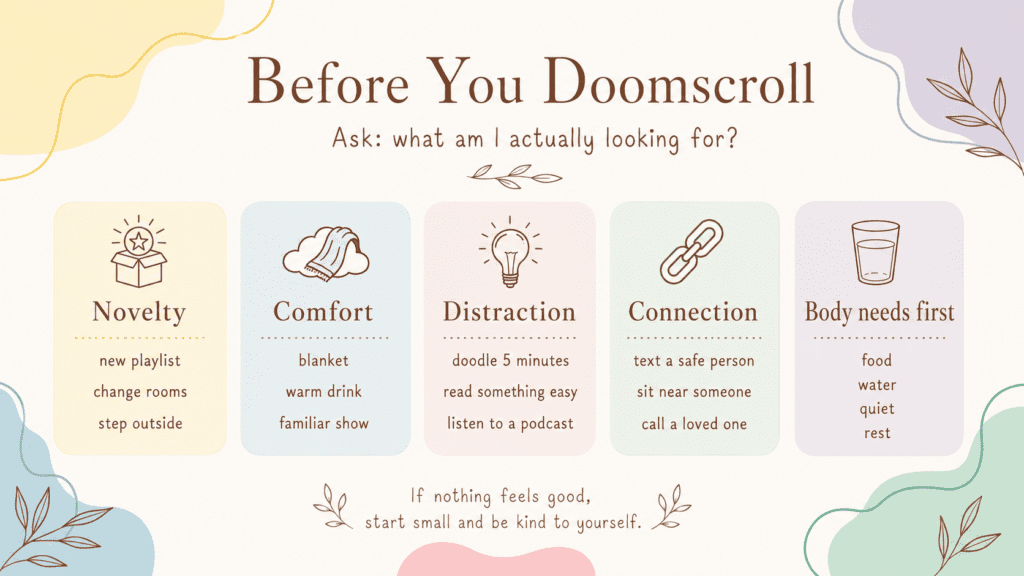
Instead of falling into the same default every time, you can ask:
“What kind of input am I actually looking for?”
And then choose something that has a better chance of leaving you feeling supported, not more drained.
Want a ready-made version?
The AuDHDDesign Dopamine Menu Printable comes with pre-categorized menu sections, a simple stimulation-based layout, and space to fill in your own options.
It is designed for ADHD and AuDHD brains that need support without turning rest, joy, or regulation into another overwhelming project.
Print only the pages you need. Fill it in at your own pace. Use what helps, skip what does not.
Your dopamine menu does not need to be perfect.
It just needs to be easier to reach than the spiral.