Can’t Switch Off? Unlearning the “Always On” Mentality as a Neurodivergent Adult
You finally have a free hour.
Nothing urgent is happening. No one needs immediate attention. There is technically space to rest.
And yet your brain is already scanning.
Did I forget something?
What still needs doing?
Who might need something from me?
How could I use this time more wisely?
If you can’t switch off even when everyone around you is relaxing and they invite you to join them, you are not broken. You are not ungrateful. And you definitely aren’t actively trying to avoid spending time with your loved ones.
For many neurodivergent adults — especially ADHD, autistic, and AuDHD adults — being unable to switch off is not a personality quirk or something we actually enjoy. It is often a survival pattern. One that made sense once. One that your brain and nervous system may have been reinforcing for years.
I don’t think this is a laziness issue. I think many of us were taught to survive by staying alert, staying useful, and never quite letting our guard down.
This post is not about becoming more productive or getting your rest “right.” It is about slowly learning how to stop performing, monitoring, and proving — and understanding why that can be so much harder than it sounds.
TL;DR
If you feel guilty for resting, it may be because your brain has learned that being “good enough” means staying useful.
For many neurodivergent adults, the always-on mentality can come from:
- years of masking
- unfinished tasks that never feel fully closed
- sensory overload keeping your body on alert
- late diagnosis and the pressure to “catch up”
- people-pleasing and fear of being seen as lazy
- medication pressure, where a focused window feels like something you have to “use properly”
Unlearning this starts by noticing the rule underneath the guilt:
“I have to earn rest by being productive first.”
From there, the goal is not to force yourself to relax. It is to lower the demand slowly through:
- sensory rest
- transition time
- smaller expectations
- protected downtime
- capacity-based planning
Rest is not laziness, wasted potential, or proof that you are failing.
It is maintenance, recovery, and part of having a life that does not require you to be endlessly switched on.
What Does It Mean When You Can’t Switch Off?
The always-on mentality is often described as a productivity problem.
But it goes much deeper than how much you are doing.
Being “on” can mean feeling like you always need to be:
- productive, or at least visibly making progress, especially when you are being perceived
- reachable, in case someone needs you
- useful, to justify your presence
- prepared, so nothing catches you off guard
- improving, because you are always behind somehow
- emotionally regulated, so you do not burden anyone
- catching up, on everything that slipped
- proving, constantly, that you are not lazy
But always-on mode is not only about visible output. Some of the most exhausting parts of it are invisible.
It can look like rehearsing conversations in advance or replaying them afterward. Tracking the moods of everyone around you. Scanning for mistakes you might have made. Mentally holding open every unfinished task like a browser tab you cannot close. Anticipating sensory discomfort before it arrives. Trying to appear fine when you are not.
Being “on” is not only about visually being busy.
Sometimes it is about constantly monitoring.
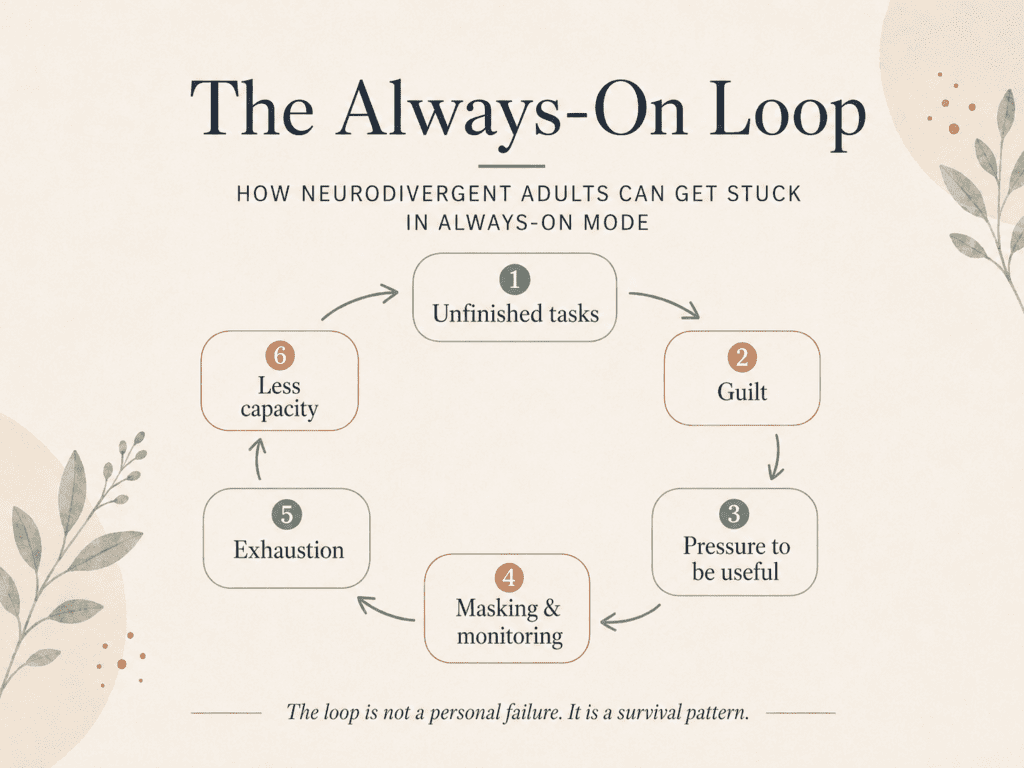
Why Neurodivergent Adults Get Stuck in Always-On Mode
There is rarely a single reason.
For most people, always-on mode comes from a mix of neurological patterns, past experiences, and systems that were never designed with neurodivergent nervous systems in mind.
Masking Can Make Your Brain Monitor Everything
Masking — hiding, suppressing, or compensating for neurodivergent traits to appear more “acceptable” — is not something most of us chose consciously.
It often started as a way to avoid being corrected, excluded, misunderstood, or seen as too much.
But over time, masking trains the brain to run a near-constant background scan.
Tone of voice: is it okay?
Eye contact: am I making the right amount?
Body language: does this look natural?
Social timing: should I speak yet, did I interrupt, was that too much?
This level of monitoring is exhausting.
And it does not always switch off when the social situation ends. Masking exhaustion and masking fatigue can leave the nervous system in a low-level alert state long after the actual interaction is over.
Research on autistic masking also connects masking with mental health strain, burnout, and late or missed diagnosis.
Executive Dysfunction Creates Constant Catch-Up Pressure
Executive dysfunction can affect planning, task initiation, working memory, prioritizing, and transitions.
That means things can pile up in ways that are hard to explain from the outside.
Things started and not finished.
Things forgotten and now overdue.
Things that should be simple and somehow are not.
For many ADHD and AuDHD adults, unfinished tasks do not sit quietly in the background. They hover. They interrupt. They create mental noise.
So even when nothing urgent is happening, your brain may still feel surrounded by open loops.
Rest can start to feel unearned, or even risky, because the to-do list never truly clears and you fear that you’ll never be able to catch up if you don’t do something now.
Sensory Overload Can Make Rest Feel Unsafe
Rest and sensory relief are not always the same thing.
You can be sitting still and still be processing more than your nervous system can comfortably manage.
For adults who experience sensory overload, technically resting does not always mean the body is recovering. Light, sound, texture, temperature, background noise, visual clutter, social input — all of these can continue to demand processing even when you have stopped moving.
Sensory rest means reducing input, not just reducing activity.
Many overstimulated adults have never been taught to seek that kind of rest. If the environment is still overwhelming, the nervous system may not be able to come down from alert mode until it feels completely safe.
Late Diagnosis Can Add Urgency and Productivity Guilt
For late-diagnosed adults, receiving a diagnosis can bring a complicated mix of relief and grief.
Relief that there is an explanation.
Grief for the years that were harder than they needed to be.
It can also create a particular kind of urgency: a feeling that now you need to catch up, fix everything, and finally become the person you were “supposed” to be.
Like there is lost time to make up for.
I understand that feeling as a late-diagnosed AuDHDer myself. But catch-up mode is still always-on mode.
And the urgency is often built on a painful false premise: that there is a version of yourself you owe the world, and you are late delivering them. You do not owe the world a constantly available version of yourself at the expense of your mental health. Make that your personal mantra if you need to.
I do not owe the world a constantly available version of myself. My mental health comes first. If I don’t feel stable, I won’t be able to provide the quality I would like to deliver.
Medication Can Create Pressure to “Use the Day Properly”
Some of us, including myself, use medication to support focus, regulation, or stability throughout the day. Although it might help for some people, it is not and never will be some kind of magic pill.
But we often forget that.
ADHD medication productivity pressure is rarely talked about, but is a real issue for some of us.
During low-energy days, or days when we don’t get as much done as we had hoped, we often shame ourselves or become angry at ourselves. This further reinforces that feeling of guilt for trying to relax.
These thoughts might include:
- “I’ve taken my meds, so I should be productive now.”
- “If I rest, I’m wasting the medication.”
- “This is my focus window, so I have to use it properly.”
- “If I don’t get enough done, I failed.”
I discussed this feeling with my healthcare specialist (who is also ADHD by the way), and what he said changed my view on this feeling ever since. He told me:
Neurotypical people aren’t productive 24/7 either. They also rest, have low-energy days or simply don’t feel like doing anything.
Why should you feel guilty for those exact same feelings just because you take medication?
The medication supports you and helps your neurological system feel more balanced. It is not a magic pill which turns you into some kind of productivity machine, nor is that something you should want.
Doing precisely ‘nothing’ is part of being human.
Medication can support rest, regulation, eating, showering, being present, or simply feeling more like yourself. It does not have to be spent only on output.
Productivity Culture Rewards Over-Functioning
Many neurodivergent adults, especially those who were seen as capable, easygoing, or “coping fine,” were praised precisely when they pushed through, overprepared, over-delivered, or kept their struggles hidden.
The accommodations and softness they needed were not offered. What was praised was the performance.
That praise becomes internalized.
People-pleasing burnout is not just about saying yes too often. It is about learning that being acceptable means being endlessly useful.
Learning how to stop overfunctioning starts with understanding why you started in the first place. Praise can feel good, especially when you have spent years feeling misunderstood. But praise is not worth building a life where you are only allowed to be valued when you are overextending yourself.
Signs You Are Stuck in the Always-On Mentality
This is not a checklist for self-diagnosis. It is just a list of patterns worth noticing.
You might be stuck in always-on mode if:
- You feel guilty resting unless everything is finished — which means you pretty much never actually rest.
- You turn breaks into planning sessions.
- You check your phone even when you do not want to.
- You feel tense when nothing is urgent.
- You cannot enjoy hobbies unless they feel useful or productive.
- You feel like recovery time is wasted time.
- You struggle to tell the difference between rest and avoidance.
- You feel like you should look busy whenever someone can see you, even around people who are not judging you.
- You keep optimizing your systems and routines instead of actually living.
- You feel irritated when something interrupts your decompression time.
- You feel like you have to earn basic care.
- You feel afraid of being seen as lazy.
- You feel like you should always be doing something, and that “something” is never quite enough.
If several of these feel familiar, that is useful information.
Not evidence of failure.
Why Do I Feel Guilty When I Rest?
This is often the first question people ask when they notice that they are unable to rest without feeling guilty.
Feeling guilty for resting often has very specific roots.
Many of us were praised for pushing through and criticized — or pitied, or penalized — when we struggled. We learned that effort and output are what pleases the majority of people and what make us acceptable.
Rest, by contrast, can look like the absence of effort.
Rest guilt and productivity guilt can also come from unfinished tasks that stay mentally present even when your body is still. Or from late diagnosis grief, which can bring the sense that you have already wasted too much time. But also from needing more recovery than the people around you seem to need.
I used to think I needed to finish everything before I was allowed to stop.
And there was always more to finish, especially with kids and pets. The laundry and dishes seem like a never-ending task; as soon as you finish it, there’s already a new load waiting for you.
The thing about guilt is that it does not always mean you are doing something wrong. Sometimes guilt is simply what it feels like to break old habits.
Especially a habit that was never yours by choice to begin with.
Toxic productivity — the belief that your value is tied to your output — is not a personal flaw you developed out of nowhere. It is a message many neurodivergent adults absorb from a culture that rarely accounts for the real energy costs of masking, sensory processing, executive dysfunction, and constant self-monitoring.
I am glad we are slowly talking more about mental health and less about constant productivity. But for many of us, that shift came after years of learning the opposite. We were taught the old rules first, and now we have to spend even more energy unlearning them.
Rest is not the opposite of usefulness.
It is what makes anything else sustainable.
The First Step Is Noticing the Pressure
Many people try to solve always-on mode by scheduling rest.
Add it to the calendar. Block time. Plan the afternoon off. Write it on the never-ending to-do list.
And sometimes that helps.
But for a lot of neurodivergent adults, scheduled rest can become just another task — something to do correctly, something to optimize, something to feel guilty about if it does not go as planned.
Before you add more structure, it can help to simply notice what is happening.
Not to fix it immediately.
Just to see it more clearly. To understand the reasoning behind it.
Some questions worth sitting with:
- What am I afraid will happen if I stop?
- Why do I feel like rest has to be earned?
- Am I physically tired, or am I mentally tired?
- Do I need sleep, sensory relief, emotional safety, fewer decisions, or fewer demands?
- What would I choose to do if I did not have to prove I was trying?
You do not have to answer all of these right now.
Even one honest answer can shift something.
These questions can feel confronting and you might need to search deeper than you expected for these answers, so take all the time you need. Don’t rush self-discovery.
How to Switch Off Mentally Without Forcing Yourself to Relax
Here is what I know about neurodivergent nervous systems:
“Just relax” rarely works.
Not because you are resistant, but because the brain and body need to feel safe before they can genuinely come down from alert mode.
Forcing rest often just creates a new performance.
Lying down while mentally reviewing your to-do list. Watching a show while planning what tomorrow will look like now that you feel like you need to move the tasks to tomorrow AND complete the tasks you had originally planned. Doing “nothing” while anxiously wondering if you are doing nothing correctly.
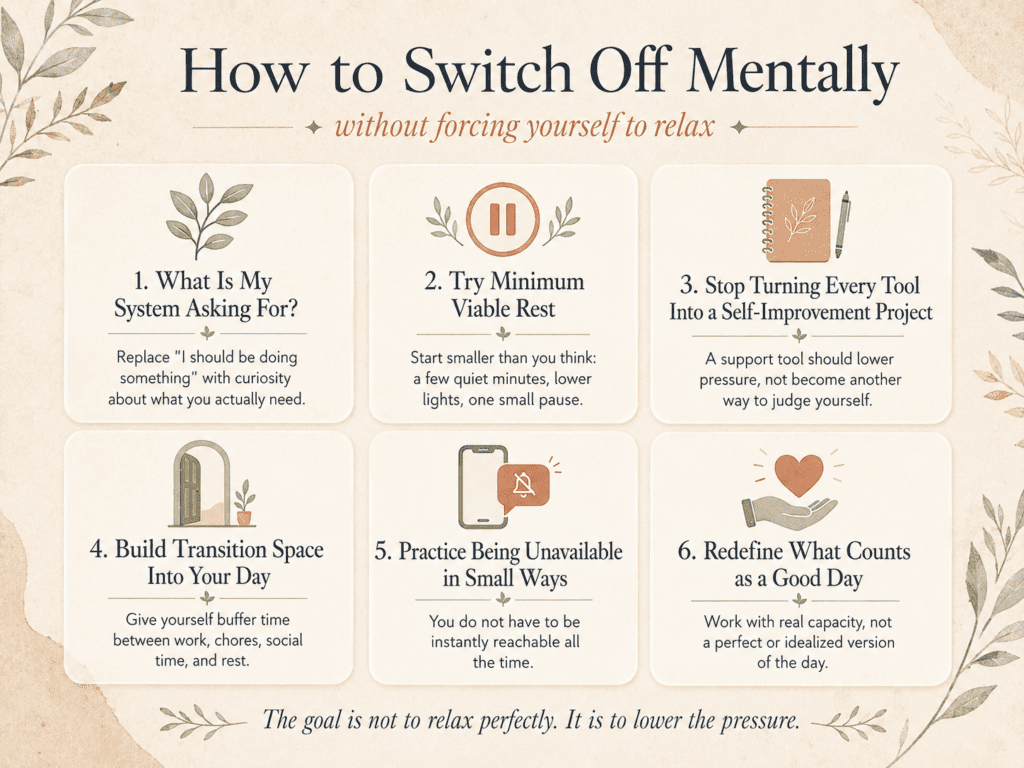
The strategies below are not about forcing yourself into calm.
They are about lowering pressure.
1. Replace “I Should Be Doing Something” With “What Is My System Asking For?”
Rest is not one thing.
Your brain and body might need:
- physical rest, like lying down or reducing movement demands
- sensory reduction, like less noise, light, or visual input
- emotional safety, like quiet, predictability, or fewer social demands
- food or water
- movement, because sometimes the body needs to move before it can settle
- fewer decisions
- a smaller, more manageable next step
- connection, if being alone is making the anxiety louder
- quiet, in the simplest sense
Getting curious about what you actually need is often more useful than trying to switch off on command.
2. Try Minimum Viable Rest
Deep, restorative rest can feel completely out of reach, especially if you are already in burnout or close to it.
So start smaller.
Minimum viable rest might look like:
- sitting somewhere comfortable without a goal for three minutes
- lying down without trying to nap
- eating something without also scrolling
- dimming the lights in one room
- putting your phone on the other side of the room
- using headphones to reduce background noise
- doing one thing slowly and deliberately, not efficiently
- letting yourself stop after one small task instead of turning it into five
These are not substitutes for deeper recovery.
But they can begin to teach the nervous system that slowing down is not dangerous.
3. Stop Turning Every Tool Into a Self-Improvement Project
I know how easy it is to turn rest into another thing to do correctly.
And I have watched people do the same thing with planning tools — turning a simple tracker into a new system of self-judgment.
Planners, apps, routines, Notion dashboards, habit trackers, dopamine menus, checklists — these things can be genuinely useful.
But they are only useful if they lower pressure. If they support you.
Not if they give you more ways to measure whether you are doing life correctly.
A support tool is working if it lowers pressure, not if it gives you more ways to judge yourself.
If a system makes you feel more behind, more inadequate, or more anxious about your capacity, that is information worth paying attention to.
It’s also important to remember that what might work for one person, doesn’t necessarily have to work for you. It is also worth remembering that what works for one person does not have to work for you. A tool that supports someone else might add pressure for you, and that does not mean you failed. We are all wired differently. But I can promise you that there is definitely something which can support you in the way you need, even if you haven’t found it yet.
4. Build Transition Space Into Your Day
Neurodivergent adults often need more buffer time between states than they have been taught to allow.
Transitions are real demands.
Work to home.
Social time to alone time.
Errands to chores.
Screen time to sleep.
Task to task.
Masking to unmasking.
A realistic transition buffer might be:
- ten minutes in the car before going inside after work
- a short walk between tasks
- changing clothes before starting anything new
- five minutes of nothing before the next commitment
- headphones during transit to begin decompressing earlier
- sitting in silence before answering messages
These buffers are not inefficiency or wasting time.
They are what make the next thing possible.
5. Practice Being Unavailable in Small Ways
If you have been “on” for years, complete unavailability can feel impossible or even frightening.
So practice in smaller doses.
Not replying to a message the moment it arrives.
Saying “I’ll get back to you tomorrow” and following through on that.
Leaving one non-urgent email unread until the morning.
Having a quiet evening without explaining it to anyone.
Not filling every empty window with a task.
Protecting decompression time after work or social plans, even if it is only fifteen minutes.
Every time you practice this without catastrophe following, you are proving to yourself that being unavailable is survivable.
6. Redefine What Counts as a Good Day
A good day is not always a productive day.
Especially for a neurodivergent nervous system.
Some genuinely supportive wins:
- stopping before you crash, instead of after
- eating something easy when you don’t have the energy to cook a full meal
- asking for clarification instead of guessing and spiraling
- choosing sensory relief before overwhelm becomes shutdown
- doing one genuinely important task instead of ten fake-urgent ones
- taking a break without immediately punishing yourself for it
- lowering the demand instead of forcing a plan that was never realistic
This is what capacity-based planning actually means: working with your real energy on a real day, not the idealized version.
ADHD energy management is not about doing more.
It is about spending energy in ways that do not leave you completely depleted.
What to Do When Rest Feels Uncomfortable
Discomfort during rest does not mean rest is wrong.
It often means rest is unfamiliar.
If you don’t know where to start, try this rest ladder. Begin at whatever level feels actually possible — not the level you think you should be at.
Level 1: Reduce Input
Dim the lights. Lower the volume. Change into softer clothes. Reduce visual clutter. Close some browser tabs.
Level 2: Remove One Demand
Delay one reply. Simplify dinner. Postpone one non-essential task. Lower the expectation for one hour. With non-essential, we need to teach ourselves that this means any task which will not harm others if we leave it untouched for now.
Level 3: Passive Rest
Watch a familiar show you do not have to follow closely. Lie down without trying to sleep, but don’t fight the sleep if it does want to happen. Listen to calming audio. Sit outside without turning it into a task and just take in the fresh air.
Level 4: Unstructured Rest
No task.
No goal.
No self-monitoring.
No optimizing.
Just being somewhere without needing to justify what you are doing.
Level 5: Protected Recovery
A longer, intentionally protected period where you are unavailable.
No commitments. No checking in. No output.
Start where you are.
Not where you think you should be.
A Simple Reset Exercise for When You Can’t Relax
The 5-Minute Pressure Check
When you notice the pressure building, try this.
1. Name the pressure:
“I feel like I should be…”
2. Name the fear underneath:
“If I don’t, I’m afraid…”
3. Name your actual capacity:
“Right now, I realistically have energy for…”
4. Choose one supportive action:
“I will…”
5. Close the loop:
“Stopping here is allowed.”
Here is what that might look like:
“I feel like I should clean the whole kitchen. If I don’t, I’m afraid I’m falling behind and failing. Right now, I realistically have energy to clear the sink. I will do that and then stop. Stopping here is allowed.”
It might feel strange at first.
That makes sense.
It goes against everything you’ve been conditioned to think and do. But you can practice giving it to yourself in small doses.
Gentle Scripts for Productivity Guilt
Sometimes you do not need a framework.
You just need a sentence that interrupts the spiral.
Borrow one of these:
- I am allowed to stop before I collapse.
- Rest is not a reward for being useful. It is part of being human.
- My worth does not reset to zero when I am not productive.
- I can need recovery even if nothing dramatic happened.
- Doing less now may protect my ability to do anything later.
- This is not laziness. This is maintenance.
- I do not have to earn softness by burning out first.
- Stopping is a decision, not a failure.
You do not have to believe these fully yet.
You just have to let them exist in the same space as the guilt.
How This Connects to Neurodivergent Burnout
Staying in constant output mode is not just tiring.
Over time, it can contribute to something deeper.
Many neurodivergent people describe burnout as more than ordinary tiredness. It can feel like a loss of access to skills or capacities that were previously manageable, a reduced ability to mask, deeper sensory sensitivity, and a need for withdrawal that does not disappear after one good night of sleep.
ADHD burnout and autistic burnout are experiences many neurodivergent adults describe as real, serious, and deeply disruptive.
And recovery usually requires more than a better planner or a few days of pushing through differently. It’s not uncommon for real recovery to take weeks or even months.
If you have been running in always-on mode for years — especially if you have been masking heavily, pushing through sensory overload, or managing life without support — the tiredness you feel may be more than accumulated stress.
It may be a sign that your nervous system needs significant rest, reduced demands, and support that does not require you to prove you are struggling enough first.
Keep in mind that this post is not a diagnosis or treatment plan. It is simply information you might be able to relate to and understand that you are not alone in feeling this.
A lot of us have felt like we were watching everyone else move through life more easily, not realizing there were other people feeling just as stuck behind their own fogged-up glass.
If you feel unable to function, are in severe distress, or feel like you have been in long-term survival mode without relief, support from a qualified professional who understands neurodivergent experiences may help.
Support should not have to be another thing you earn.
FAQ
Why can’t I switch off even when I have free time?
For many neurodivergent adults, the brain has learned to stay alert as a form of protection — against forgetting things, missing social cues, falling behind, or being caught unprepared.
Free time does not automatically mean the nervous system feels safe enough to stop. Switching off often requires repeated experiences of safety, not just an empty calendar.
Why do I feel guilty when I rest?
Rest guilt often comes from being praised for pushing through and criticized when you struggled. Over time, your brain may learn to connect output with safety, approval, or worth.
Guilt is not always proof that you are doing something wrong. Sometimes it is simply the feeling of breaking an old rule.
Is feeling always on common with ADHD?
Many ADHD adults describe feeling mentally restless, alert, or unable to fully settle, even during downtime.
Unfinished tasks can stay mentally active, transitions can be hard, and the brain may struggle to move from “doing mode” into rest. That does not mean you are dramatic or trying to make things difficult. It means switching states may take more support than you were taught to expect.
Can masking make it hard to relax?
Yes. Masking requires sustained monitoring of your own behavior, tone, expressions, and environment.
That level of vigilance can continue even after the social situation ends. Sometimes what looks like rest is still full of internal performance and self-checking.
What is the difference between rest and avoidance?
Avoidance usually means turning away from something specific that needs attention. Rest is a genuine reduction in demand.
But in real life, the difference can be messy. When you are depleted or burned out, even avoidance may be a signal that your capacity is lower than you want it to be. The goal is not to shame yourself into action, but to ask what kind of support would make the next step possible.
Final Takeaway: You Are Allowed to Have an Off Switch
Unlearning the always-on mentality does not happen in one quiet evening with a scented candle and a plan.
It happens in small moments.
Noticing the pressure.
Softening the rule slightly.
Choosing capacity over performance just this once.
For a long time, I thought being constantly switched on meant I was being responsible, like I had finally learned how to ‘adult’ properly. It took a while to understand that it actually meant I had learned to survive by never feeling safe enough to stop.
If that resonates with you, I want to be clear: that is not a character flaw.
It is a very logical response to the experiences that shaped you.
You are not here to be endlessly available, endlessly productive, or endlessly improving.
You are allowed to have an off switch.
And you are allowed to find it slowly, on your own terms, without having to earn it first.
Gentle Next Steps
If planning by pressure keeps pushing you toward shutdown, you might find it useful to try a different approach — one that starts with your actual capacity rather than an idealized version of the day.
This is especially true on the days when a traditional planner feels too demanding, but having no structure at all makes everything louder.
The tools at AuDHDDesign are built around that idea.
Not more pressure. Not more self-monitoring. Not another clever system to keep up with.
Just gentler ways of working with the energy and capacity you actually have.