How to Get Unstuck: Low-Energy Strategies for Executive Dysfunction
When you are stuck, it is tempting to think you just need to be stricter with yourself. More discipline. More pressure. More internal yelling. But if that worked, you probably would not still be sitting there, fully aware of the task and somehow unable to start — which is why learning how to get unstuck from executive dysfunction starts with building support, not adding more shame. We now know why “just do it” doesn’t work for a lot of ADHD brains, so let’s take a look at some strategies for executive dysfunction which might actually help us get started.
The broken ignition switch analogy
A useful way to imagine executive dysfunction is to think of your brain like a car.
Laziness might look like sitting in the parked car with the engine off, choosing not to drive anywhere. You are comfortable. You have enough things around you to keep you entertained, fed and taken care of. You know you are not going. That is the choice you are making.
Executive dysfunction is different.
Executive dysfunction is sitting in the driver’s seat, turning the key, pressing the pedals, watching the dashboard light up, but constantly hearing the engine sputter as it’s doing its very best to turn on but nothing is happening.
The intention is there.
The urgency may be there.
The stress is definitely there.
But the system that turns “I should do this” into “I am doing this” is not connecting smoothly.
That does not mean you are weak. It does not mean you do not care. It means your brain may need more support between noticing the task and starting the task.
What to do when your brain freezes
The answer is not “try harder.”
You’re already trying your hardest, and you’ve come to the realization that the issue isn’t your willpower.
A better starting point is to lower the friction.
Executive dysfunction often improves when the task becomes smaller, clearer, more visible, or less emotionally loaded.
Try asking:
“What is the tiniest next step I can physically see?”
Not the most impressive step.
Not the step that would fix everything.
Not the step that would make this a productive day.
Just the next visible step.
For example:
Instead of “clean the kitchen,” try:
- Touch the sponge
- Put one cup in the sink
- Throw away one piece of trash
- Open the dishwasher
- Clear one tiny corner of the counter
Instead of “answer all my messages,” try:
- Open the messaging app
- Pick one message
- Type “I’ll reply properly later”
- Send one sentence
- Close the app again
Instead of “sort my life out,” try:
- Write everything in a brain dump
- Circle one thing
- Choose one tiny next step
- Stop there if needed
The point is not to trick yourself into doing a full task every time.
The point is to create movement without needing shame as fuel. You are giving yourself permission to move at a speed suitable for your current state of mind.
Sometimes one tiny step becomes five. Sometimes one tiny step is all you have. Both count. Using an energy-based visual schedule can help you plan what to do before you get stuck. For example, my visual schedule has two spots for low, medium and high energy, so I know what I can fall back on if my energy suddenly drops to zero throughout the day.
How to get unstuck from executive dysfunction
- Choose one visible step: Pick an action you can physically see, such as touching the sponge or opening the laptop.
- Make the task smaller: Shrink the task until your nervous system stops treating it like a threat. The first step should make you feel a sense of ‘yes, this feels doable’.
- Remove one decision: Choose the first step in advance, or use a card, list, or visual prompt to choose for you.
- Use body doubling: Let another person’s presence create a gentle starting point.
- Lower the sensory friction: Change the lighting, put on gloves, reduce noise, or make the environment easier to enter.
- Use a timer gently: Try five minutes as an opening, not as a demand to finish. It is not a race against the clock, it’s support which keeps you grounded without losing track of the actual time.
- Allow the imperfect version: Send the short reply, clear one corner, wash only cups, or move the mug closer to the kitchen. Baby steps are still steps.
- Stop before you crash: Leave some energy for later instead of spending everything at once.
The goal is not to become a perfectly optimized person.
The goal is to build a bridge between stuck and moving. To reset yourself to ‘functioning’ instead of ‘out of order’.
Low-energy versions still count
One of the most helpful shifts is to stop treating every task as all-or-nothing.
A task can have versions, just like an exercise move can have versions.
There is the full-energy version.
There is the medium-energy version.
There is the “bare minimum but still helpful” version.
For example:
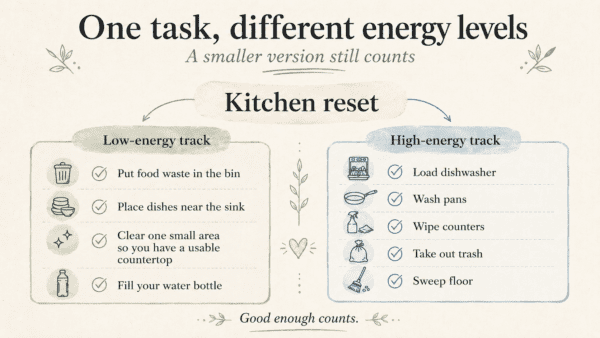
Full-energy kitchen reset:
- Load dishwasher
- Wash pans
- Wipe counters
- Take out trash
- Sweep floor
Low-energy kitchen reset:
- Put food waste in the bin
- Place dishes near the sink
- Clear one small area so you have a usable countertop
- Fill your water bottle
- Stop
That low-energy version is not failure.
It is support.
It keeps the task from becoming bigger tomorrow. It gives your brain a visible win. It respects the fact that energy, sensory capacity, attention, and emotional regulation are not the same every day. And it still creates a space you can safely live in.
This is one of the reasons flexible systems tend to work better for ADHD and AuDHD adults than perfect routines.
Perfect routines often collapse the moment real life happens.
Flexible systems leave room for bad brain days, low-energy days, interruptions, sensory overload, hormones, family life, work stress, unexpected events and the simple fact that humans are not machines.
A note on pacing and energy
If you often swing between “doing everything at once” and “crashing completely,” it may help to think in terms of energy, not just time or to-do lists.
Many neurodivergent adults are used to pushing until they cannot push anymore.
You finally get momentum, so you use all of it. You clean the whole room, answer every message, reorganize your entire planner, do three loads of laundry, and convince yourself you are finally back on track.
Then the next day, you crash and wonder why you can’t perform even half as efficiently as you did yesterday.
This is the boom-and-bust cycle.
A gentler approach is to protect some energy on purpose.
This idea is inspired by pacing frameworks used in chronic illness spaces, where people are encouraged to stay within their available energy instead of repeatedly pushing past their limits. While that framework was not created specifically for ADHD, the basic idea can still be useful for neurodivergent daily life:
Do not spend every bit of capacity just because you have it today.
Leaving a buffer is not laziness. That buffer is essential to making sure you don’t burn out.
It is how you make tomorrow possible.
For ADHD and AuDHD adults, this can be especially important because masking, sensory processing, transitions, decision-making, and emotional regulation all use energy too. You may be spending more capacity than you realize before the “actual task” even begins.
So instead of asking:
“How much can I force myself to do today?”
try asking:
“What can I do without stealing from tomorrow?”
That question changes everything.
Helpful support tools for executive dysfunction
You do not need a perfect productivity system.
You need fewer steps between you and the next step.
Helpful support tools for executive dysfunction can include:
- A brain dump to get thoughts out of your head
- A visual schedule so tasks do not disappear
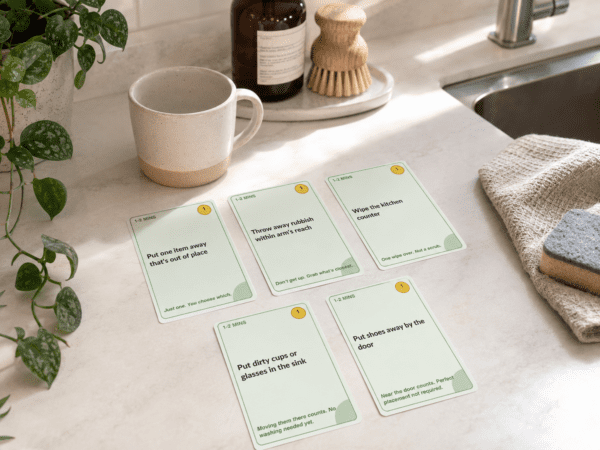
- Low-energy task cards for days when choosing is too much
- A simple reset routine for when the day has gone sideways
- Body doubling, even quietly over video or in the same room
- Timers used gently, not as a threat
- Checklists that show the first step, not just the final outcome
- Permission to do the smaller version
This is also the kind of support I build into my printable tools at AuDHDDesign: visual, low-pressure resources for stuck days, low-energy days, and “I know what I need to do but I can’t start” days.
The goal is not to suddenly become the absolute best version of yourself.
The goal is to lower the friction enough that starting feels possible.
You are not failing because you need support
The next time your brain locks up in front of a task that “should be easy,” try to pause before calling yourself lazy.
Ask what is actually happening.
Is the task too vague?
Are there too many hidden steps?
Is your body exhausted?
Is shame making the task heavier?
Do you need the first step chosen for you?
Do you need a lower-energy version?
Executive dysfunction does not mean you do not care.
Often, it means you care deeply, but the bridge between caring and doing is harder to cross.
Start smaller than you think you should.
Touch the sponge.
Open the draft.
Move the mug closer to the kitchen.
Write one thing down.
Good enough counts.
And if all you did today was notice that you are stuck without turning it into a character flaw, that counts too.
That is the real difference in executive dysfunction vs laziness: laziness feels like ease; executive dysfunction feels like needing a smaller, kinder doorway into action.