What Is Capacity-Based Planning for ADHD? A Gentler Way to Plan Your Workday
You’ve tried the color-coded calendar. The time-blocking app. The productivity journal with the little checkboxes. Maybe you even downloaded a new system or watched forty minutes of YouTube videos about “getting your life together”. And I’m sure we’ve all convinced ourselves at some point that this planner would finally be the one. Yes, that planner which is now gathering dust somewhere at the bottom of a drawer, that one.
It worked — for about three days.
If that story sounds familiar, you’re not broken, lazy, or too chaotic. You’re just someone whose brain doesn’t run on the same fuel every day. Capacity-based planning for ADHD is a gentler framework that accounts for that reality. Not by making you try harder, but by helping you work with the mental, emotional, and sensory resources you actually have available.
This isn’t another gentle productivity trend dressed up in pastel colors with the word ‘ADHD’ slapped on it. It’s a different way of looking at work: one built around what you can realistically do, not what a calendar says you should be doing by 10 AM.
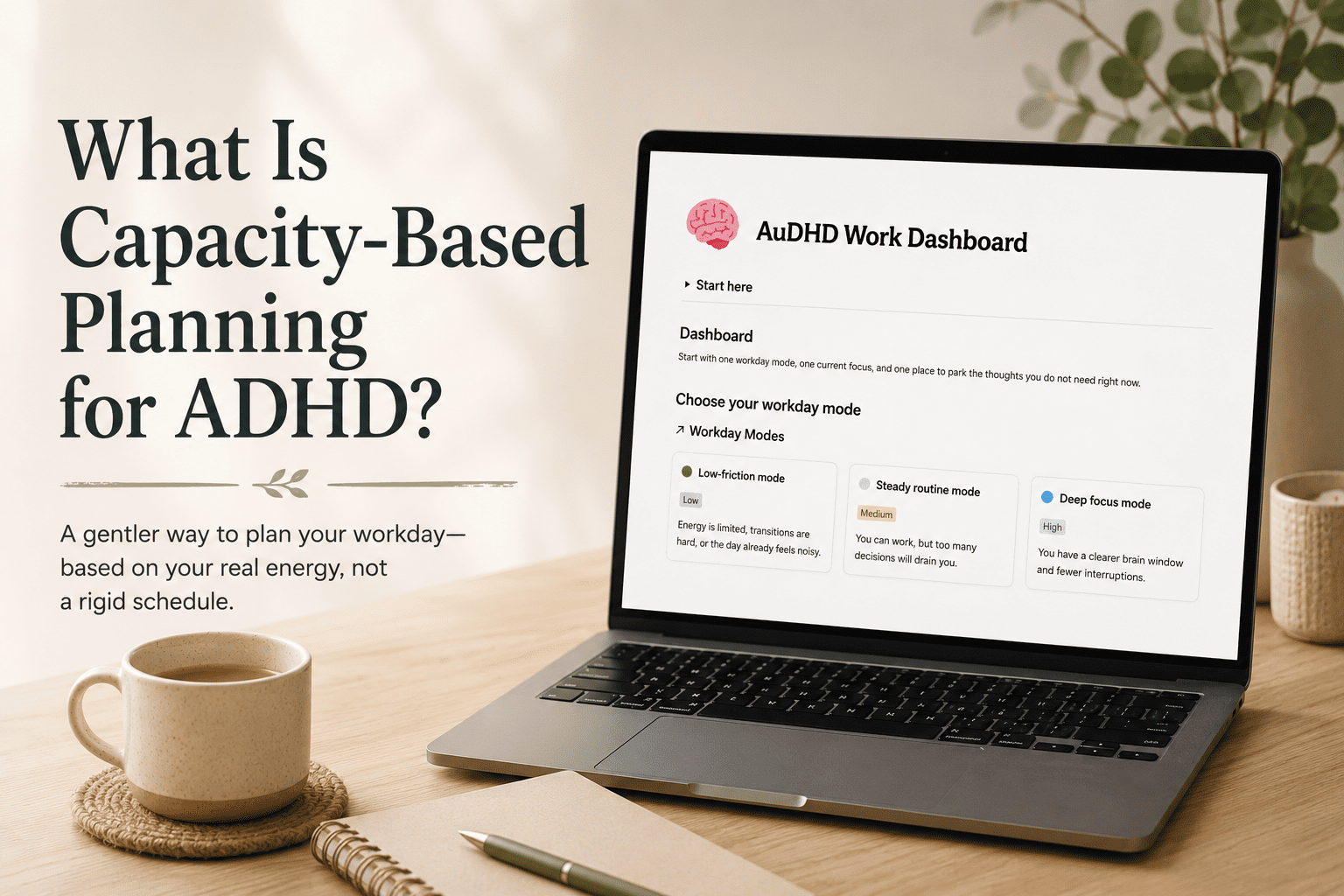
That’s also the idea behind the AuDHD Work Dashboard: a Notion workspace built around capacity, task friction, and realistic workdays instead of rigid productivity rules.
Why Traditional Systems Fail: Energy Management vs Time Management
Here’s the core problem with most productivity advice: it treats all hours as equal.
A 9 AM slot on your calendar looks the same as a 2 PM slot. An empty Tuesday looks identical to a Tuesday after a stressful Monday. A task that takes twenty minutes on a clear-headed morning is treated as if it should still take twenty minutes when you’re overstimulated, exhausted, interrupted, or already emotionally drained.
Time-management systems often assume that your brain wakes up with the same capacity every day, processes tasks in a linear order, and experiences no meaningful friction between “deciding to start” and actually starting.
That is not an ADHD brain. That is not an autistic brain. Honestly, it’s not even how the average brain works, neurodivergent or neurotypical.
When you live with fluctuating executive function — where initiation, working memory, emotional regulation, and sensory tolerance can shift from hour to hour — time is not always the most useful unit of measurement. The real resource you’re working with is capacity: the amount of mental, emotional, and sensory bandwidth your brain has available right now.
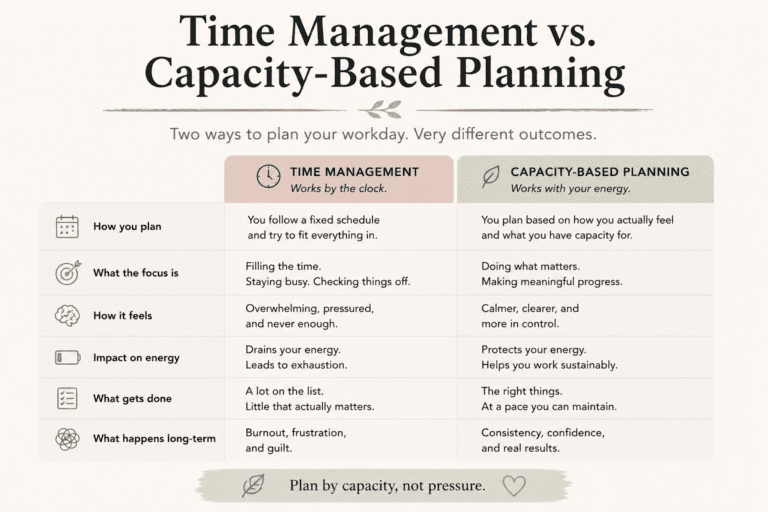
Here’s what the difference looks like.
Time management says:
- You have eight hours in a workday, so you should accomplish eight hours of work.
- Block focused work from 9–11 AM, emails from 11–12, and meetings after lunch.
- If you didn’t finish, you either didn’t try hard enough or plan well enough.
- The system should stay the same every day because every day is structurally the same.
Energy management says:
- Your available bandwidth changes depending on sleep, sensory load, meeting density, emotional state, hormones, stress, transitions, and dozens of other factors.
- A “two-hour task” might take twenty minutes on a good day and feel completely impossible on a low-capacity day.
- What matters is matching the right kind of task to your actual current state.
- Some days, the most strategic thing you can do is choose one small visible thing and call it a success.
This is the foundation of capacity-based planning: you stop asking, “How much time do I have?” as the only question.
Instead, you ask:
What do I actually have the capacity for today?
That shift matters. Because the shame that comes from failing traditional systems often makes complete sense. The systems were not built for the way you actually work. This often causes outsiders to think it’s simply laziness instead of executive dysfunction.
Moving Beyond the Grid: Practical Alternatives to Time Blocking
Time blocking looks great on paper. In practice, for a lot of neurodivergent people, it creates a very specific kind of spiral.
You block 10–11 AM for “deep work.” At 10:03, something interrupts you. Or the task feels too vague to start. Or you open the document and immediately realize you need three other pieces of information first. Or your brain simply refuses to move. All of this can lead to what many people call ADHD paralysis: that frozen, stuck feeling where you want to continue, but you can’t seem to make yourself get into action.
Now it’s 10:45 and you still haven’t started.
The block is ruined. And because the rest of the day was planned around that block happening, the whole structure starts to crumble. Suddenly, it feels like the entire day is a failure before lunch. You struggle to find your rhythm again and suddenly every task feels urgent causing you to spiral into overwhelm.
This is where planning fatigue often starts: not because you don’t care, but because the system asks you to predict your future capacity with a level of certainty your brain simply does not have.
Rigid planning systems punish variability. And variability is not a character flaw. It is a real part of how many ADHD and AuDHD brains function. Yes, we need structure, but we also need a safety-net for when that structure suddenly collapses — regardless of the cause of that collapse.
That is why capacity-based planning is one of the most practical alternatives to time blocking. It does not assume your brain will behave predictably. Instead of asking:
What will I do from 10 to 11?
it asks:
How much capacity do I have right now?
What kind of task matches that capacity?
What is the single most useful thing I can actually start?
This matters because task friction is real.
Task friction is the invisible resistance between you and the start of something. It can come from unclear instructions, too many steps, emotional pressure, sensory overload, perfectionism, uncertainty, transitions, or the simple fact that your brain does not know where to begin.
A task that feels completely doable on Thursday might feel immovable on Monday. A capacity-based approach respects that. It does not put you in a box and then blame you when the box does not fit.
It also creates a kinder relationship with your own output. When you match tasks to capacity instead of forcing them into clock slots, you stop experiencing normal human variability as personal failure. Over time, this can make planning feel less stressful — and may help you make more meaningful progress than when you were trying to force everything into rigid time blocks.
How to Start Capacity-Based Planning at Work
Capacity-based planning does not need to be complicated. In fact, the simpler it is, the better.
If your planning system requires a long weekly review, seventeen databases, six color codes, and a perfectly maintained routine, it may create more pressure than support. A good ADHD-friendly planning system should reduce cognitive load, not become another thing you have to keep alive. Ideally, you want it to work as a second brain.
At its core, energy based planning is about choosing tasks based on the bandwidth you actually have, not the productivity you hoped you would have.
Here are the three core pillars.
1. Sort Tasks by Energy Required — Not Just Importance
Before you touch your to-do list in the morning, assess what you are working with.
Not what you wish you had.
What you actually have.
Then look at your tasks through that lens.
High-energy tasks might include:
- drafting something from scratch
- making a difficult decision
- having a complicated conversation
- planning a project
- solving a problem without clear instructions
- doing anything that requires sustained focus or creativity
These are not bad tasks. They just need more capacity. Trying to force them into a low-capacity moment often creates paralysis, avoidance, or shame.
Medium-energy tasks might include:
- reviewing notes
- preparing questions
- organizing information
- editing something that already exists
- responding to messages that need some thought
- doing structured reading or light planning
These tasks still require focus, but they usually have more structure than deep work.
Low-energy tasks might include:
- updating a tracker
- sending a short reply
- filing something
- checking one small admin item
- copying information into the right place
- choosing tomorrow’s first task
Low-energy tasks are not ‘fake’ work. They are often the anchors that keep a workday from disappearing completely and are just as valuable as bigger tasks.
The goal is not to avoid hard work. The goal is to stop forcing high-focus tasks into low-capacity windows and then treating the struggle as a personal flaw.
Sometimes the most productive choice is not the biggest task. It is the task that actually fits the nervous system you have today.
2. Filter by True Urgency — Not Just Noise
Not every task that feels urgent actually is.
A lot of work pressure comes from urgency that is not real. Something feels urgent because someone asked loudly but gave no actual deadline. Because it arrived most recently. Because it has been sitting in your inbox. Because your nervous system is treating it like an emergency.
For ADHD brains, that urgency can be especially hard to sort. Everything can feel equally loud, which makes it difficult to know what actually needs your attention.
Before deciding what to do next, run the task through a quick filter:
- Is this a real deadline, or does it just feel pressing?
- Am I doing this because it is actually the priority, or because it arrived most recently?
- If I park this for two hours, what actually happens?
- Does this need action, clarification, or just a place to land?
A useful three-option decision for anything incoming is:
A) Do now.
B) Ask for clarification.
C) Park for later.
That’s it.
Not every item deserves immediate action. Not every thought needs to become a task. Not every message needs to hijack the entire workday.
When you filter urgency before reacting, you create a little more space between the pressure and the action. That space can make a huge difference. Something you were stressing about because it felt urgent, might not need to be done for another week yet.
3. Break Tasks Down Until They Are Startable
One of the biggest causes of ADHD task paralysis is not laziness.
It is task size.
“Write the report” is not a startable task. It is a project disguised as a task. Your brain knows that. So it freezes.
A startable task has a clear, visible first action.
For example, instead of:
Write the report.
Try:
Open the report document and paste in the old section headings.
Instead of:
Prepare for the meeting.
Try:
Write down three questions I need answered in the meeting.
Instead of:
Deal with my inbox.
Try:
Find the email from Jack and decide whether it needs a reply, clarification, or parking.
These first steps can feel almost embarrassingly small. That is the point.
Small enough to start without negotiating with yourself.
Once you have started, momentum often has a better chance of showing up. But the first step has to be concrete enough that your brain can see it.
When in doubt, ask:
What is the first visible thing I could do in the next five minutes?
If you can answer that clearly, you are ready to take the first step of the task. The others steps can follow. That first step is the make-or-break moment.
A Minimalist Dashboard Designed for Real Capacity
Understanding capacity-based planning as a concept is one thing. Actually having a workspace that supports it every day is another.
This is where a lot of systems fall apart again. Even when you understand the principles, you may still end up with a complicated Notion setup, too many databases, and a weekly review ritual that takes two hours and happens roughly once in a blue moon.
A work dashboard for a neurodivergent brain should not add cognitive load.
It should reduce it.
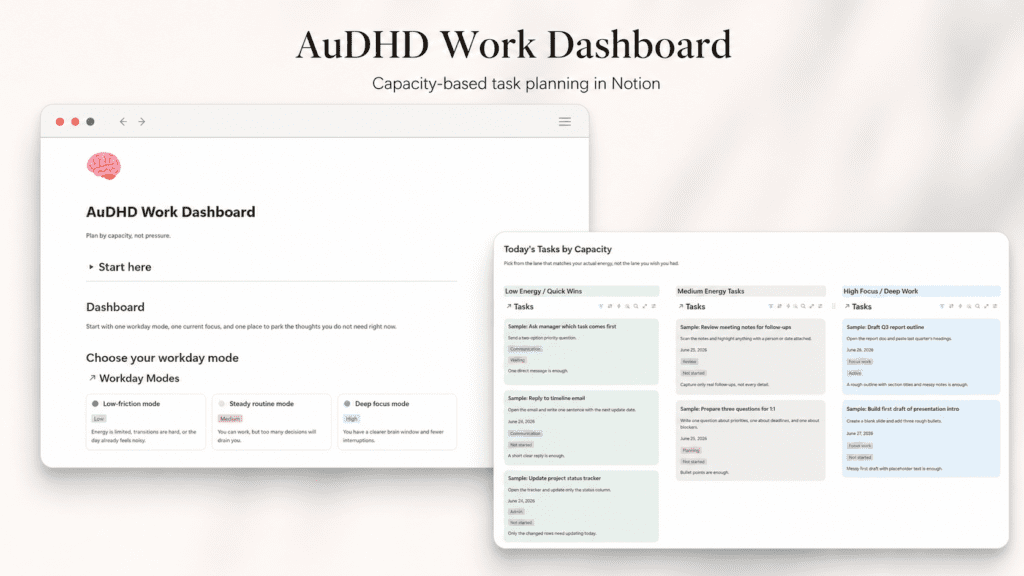
That’s the idea behind the AuDHD Work Dashboard: a Notion workspace designed to help you plan by capacity, not pressure.
Instead of asking you to become a more consistent person, the dashboard gives your workday a low-friction structure that can flex with your actual bandwidth.
It is designed to help you:
- choose a workday mode before facing your full task list
- sort tasks into low, medium, and high-capacity lanes
- pick one current active task instead of mentally juggling everything
- park distracting thoughts without turning them into urgent tasks
- use support tools when switching, starting, or clarifying work feels hard
- filter urgency before reacting to every incoming request
- log invisible work so it still counts
The goal is not to make your workspace more impressive.
The goal is to make your workload limits more visible before you accidentally set yourself up for a burnout.
Workday Modes Before Task Lists
A lot of planners start by showing you everything you need to do.
That can be overwhelming before you have even begun. You haven’t even finished your first cup of coffee yet and the huge to-do list is already staring you in the face demanding your undivided attention.
The AuDHD Work Dashboard starts with workday modes instead. You choose the kind of workday you are operating in and can handle right now: low-friction, steady routine, or deep focus.
Each mode gives you a default direction, so you are not starting from a blank page or a wall of tasks. On a scattered morning, that matters.
You do not have to decide what kind of productivity machine you are going to be.
You only have to ask:
What kind of day is this?
Tasks Sorted by Capacity Lane
The dashboard’s task view is built around capacity lanes: low energy, medium energy, and high focus.
This helps you choose from the lane that matches your actual energy, not the lane you wish you had.
On a high-capacity day, that might mean using your focus for deep work, creative work, or complicated decisions.
On a low-capacity day, it might mean choosing a quick win, clarifying one task, or doing the smallest visible next step.
Both count.
The point is not to lower your standards. It is to stop pretending that every task requires the same kind of energy.
If your energy changes to either side of the scale throughout the day, you can change your workday mode and continue with the tasks that fit your new energy level.
Parked Thoughts Without Losing the Thread
One of the most exhausting parts of working with an ADHD brain is the constant stream of “wait, did I forget something?” thoughts.
Those thoughts can interrupt your focus, but ignoring them often does not work either. If your brain is afraid the thought will disappear, it keeps pushing it back into the front of your mind. And more often than not; when we actually need that thought, it is nowhere to be found.
The Parked Thoughts section gives those thoughts a safe place to land. It is essentially a place for your brain dump.
Not every thought becomes a task.
Not every task becomes urgent.
Not every interruption gets to control the day.
It is just a holding shelf, so your brain can stop carrying everything at once.
Support Tools for Hard Moments
The dashboard also includes support tools for the moments when work gets sticky.
That includes:
- a Transition Support tool for when switching tasks feels impossible
- a Work Clarity Check for when something feels vague or overwhelming
- an Urgency Filter for separating real deadlines from pressure and noise
- communication scripts for asking for clarification, protecting focus time, or responding when instructions are unclear
These tools are not there because you are bad at working.
They are there because work often asks for invisible executive function before the actual task can even begin.
Sometimes the problem is not the task itself. It is the transition into the task. Or the unclear expectation. Or the emotional pressure around starting.
A good system should support those moments instead of pretending they do not exist.
A Work Log That Counts Invisible Work
The dashboard also includes a Work Log because work you forget still counts.
That includes planning, clarifying, resetting, preparing, context-switching, emotionally regulating, asking questions, sorting priorities, and recovering from interruptions.
A lot of neurodivergent work is invisible. You may finish the day feeling like you did “nothing” because the visible output does not reflect the amount of effort it took to stay oriented.
Logging work helps correct that.
Not in a toxic productivity way. Not to prove you were useful enough.
But to remind yourself that effort happened, even when the final result was smaller than expected. What seems like a no-brainer to one person, might feel like climbing Mount Everest for another person, so it’s important that we celebrate our own small, individual progress.
Conclusion: Give Yourself Permission to Scale Back
If you have spent years trying to fix yourself with systems built for a different kind of brain, some of that exhaustion is legitimate grief.
You were handed the wrong map and told you were bad at navigation.
Capacity-based planning for ADHD does not ask you to do more. It asks you to choose work that matches what you actually have available — and to count that as success, especially on low-capacity days.
The next time you sit down to plan your workday, try skipping the rigid time blocks. Instead, ask yourself:
What kind of day is this?
What capacity do I have right now?
What is one task that fits that?
Start there.
One task, matched to real capacity.
That is not lowering the bar. That is learning to work with your actual capacity instead of fighting it.
If you want a ready-made workspace for this, the AuDHD Work Dashboard is built around capacity-based planning: low-friction task sorting, workday modes, parked thoughts, urgency filters, support scripts, and a work log that helps invisible work count.
You do not need more willpower.
You need a system that works with your brain.